
In the previous article, we explored how to develop purposeful organisational leadership. In this post, we focus on the complexities of purposeful organisational leadership and potential remedies.
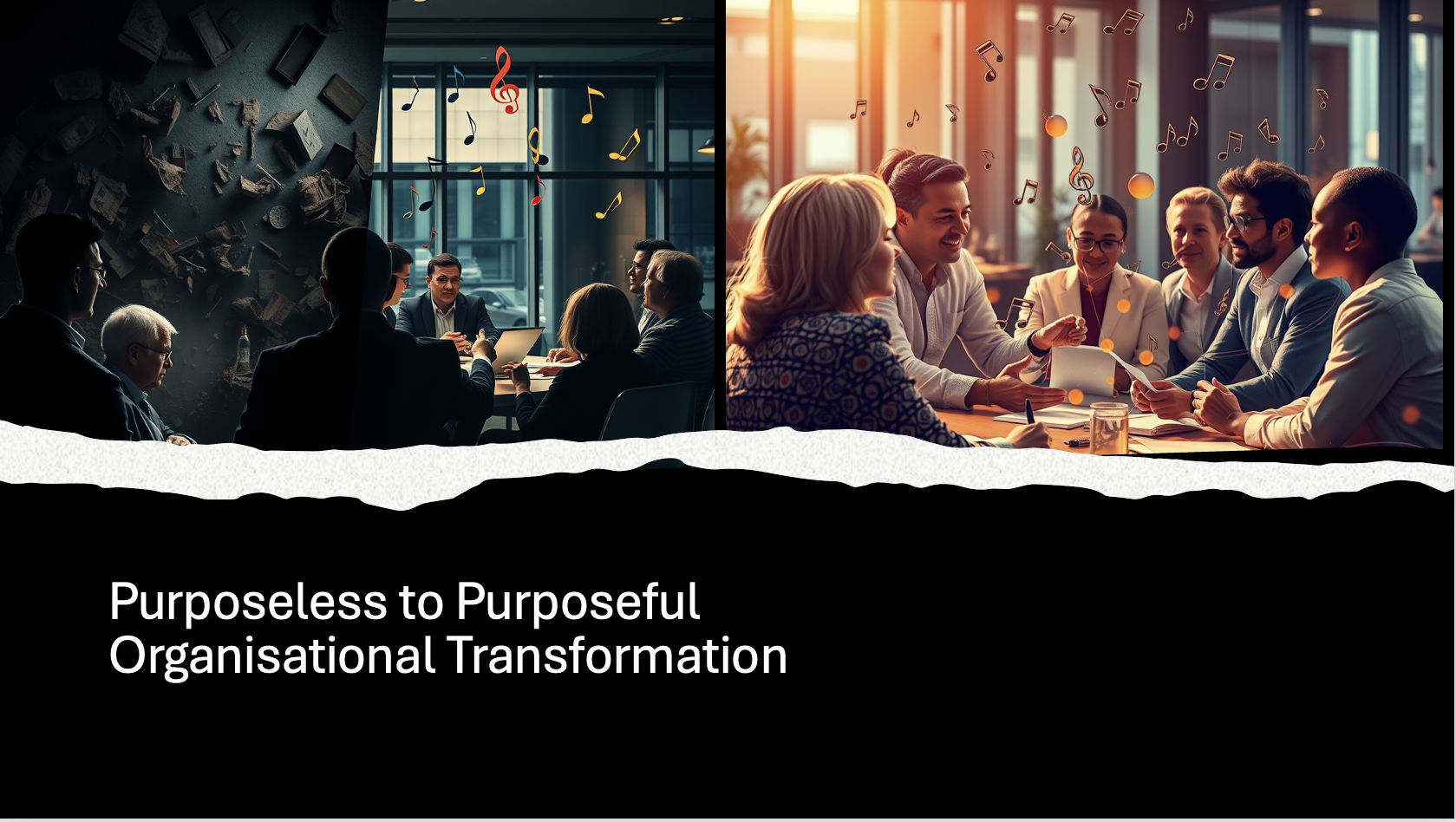
Organisations do not become purposeful by proclamation; they become purposeful by orchestration. And orchestration is complex. It asks leaders to conduct a score that balances markets and meaning, governance and grace, pace and patience. If purposeful people leadership is the dance with paradox at the human scale, then purposeful organisational leadership is that paradox amplified across systems. The stakes are higher, the variables multiplied, the pressure relentless. Yet the beauty is also greater, because purposeful organisations can hold the space where profit and flourishing meet.
The first complexity is when the purpose is only a brand. Organisations often craft eloquent purpose statements, then proceed to pursue them with methods that quietly contradict the message. Purpose is not merely narrative; it is action. When we violate this principle, people quickly learn that the banner on the wall is not the truth on the floor. To lead purposefully at the organisational level, we must ensure that strategy, structure, systems, and culture are not just aligned conceptually, but coherent behaviourally. This coherence is evident in how we behave, especially when performance pressures intensify.
The second complexity is when governance is bureaucratic. Good governance is not a bureaucratic cage; it is a set of transparent agreements about how we exercise authority, manage risk, and steward resources. The purposeful organisation refuses the false choice between compliance and care. It builds governance that invites mature discretion, enables informed dissent, and honours both accountability and learning. Policies, then, are not about control; they are about clarity. They give leaders and teams a rhythm that makes consistent goodness possible, while preserving the courage to adapt when reality shifts.
The third complexity is when culture is just a slogan. Culture is not the words we write, it is the way we behave when no one is looking, and especially when everyone is looking. Purposeful organisational leadership shapes culture intentionally by modelling, rewarding, andrepairing. We model the desired behaviours from the top, rewarding them through recognition and advancement, and we address breaches with timely accountability that is firm and fair. In this way, culture becomes the daily proof of purpose, the felt experience at work.
A fourth complexity is when we try to eliminate paradoxes. Purposeful leaders need to be bold and humble, analytical and empathetic, decisive and curious. At organisational scale, these paradoxes multiply: we must run today’s business with precision while reinventing tomorrow’s business with imagination; we must be locally attentive and globally coherent; we must drive efficiency and nurture innovation. Purposeful organisational leadership does not resolve these paradoxes; it designs forums, cadences, and incentives where these tensions are named, held, and used as fuel for progress.
The fifth complexity is when trust is an evaluation criterion. In people leadership, trust is the currency of permission; in organisational leadership, trust is the infrastructure of momentum. It enables faster alignment, better cross-functional collaboration, and honest escalation when issues emerge. Trust-building is not an annual retreat; it is the pattern of leadership in meetings, decisions, and reviews. It happens when we build bridges, close loops, share context, credit contributions, and own missteps quickly. When trust is strong, governance feels enabling; when trust is weak, the same governance feels suffocating. Purposeful leaders, therefore, treat trust not as an evaluation but as a nurtured asset.
A sixth complexity is diagnostics as verdicts. Organisational diagnostics on culture, leadership, and mindset should be mirrors, not verdicts. They create shared language, help teams see patterns, and invite intelligent action. After incorporating purposefulness into leadership development, “Icontinued to use 360‑degree and psychometric assessments, but guided coachees not to take them at face value, instead to use them for reflectionand forcreating conversations” (De Silva, 2024). When used performatively, diagnostics become part of the rehearsal: see, reflect, adjust, perform, learn, renew. The maturity lies in refusing to weaponise data and silence dissent, but to use evidence to elevate conversation.
The seventh complexity is to incentivise only the numbers. What we measure moves. If our KPIs focus narrowly on short-term financials (numbers), we harvest behaviours that undermine culture and values. Purposeful organisations build balanced scorecards that honour human flourishing, operational excellence, customer success, and sustainable growth. This balance is not cosmetic; it is operational, encouraging continuous improvement and learning. It shapes reviews, promotions, and investment decisions. When incentives are anchored to values and numbers, purposefulness flourishes.
An eighth complexity is disregarding diversity. Organisational leadership must design for cognitive diversity and digital realities. Communication rhythms, meeting designs, and knowledge flows should respect varied attention patterns across generations and roles. We do not pander; we enable inclusion. We craft platforms and practices where information is accessible, decisions are transparent, and asynchronous work is truly valued. Attention is our scarcest organisational resource; purposeful leadership treats it with respect.
The ninth complexity is disturbing the natural flow. Transformation programmes often fail not because the mission is wrong, but because the execution and cadence are mismatched. Purposeful organisations build change as a sequence of clear milestones, capability lifts, and learning loops. They admit constraints, design around them, and show visible progress to maintain belief. They also sustain recovery, recognising that people and systems need restoration, not just resilience. If not, we mortgage the future to pay for the present.
A tenth complexity is encouraging toxic behaviour. Purposeful organisations protect what makes them healthy. They set boundaries against corrosive behaviours, ethical shortcuts, and cultural dilution. Stewardship is not resistance to new ideas; it is the protection of essence. Leaders articulate the non-negotiables; the values, standards, and ways-of-working that define who we are and then invite creativity everywhere else. This clarity reduces friction and increases speed, because people know which walls are structural and which are movable.
How then do we lead purposefully across an entire organisation?
“I learnt that… purposefulness was a glue that could hold both inner pursuitsandouter pursuits together” (De Silva, 2024). We begin with inner–outer alignment; leaders who are anchored in meaning and ethics are less likely to instrumentalise people and more likely to steward systems wisely. We design culture as behaviour, diagnostics as dialogue, governance with humanity, incentives with balance, and change with cadence. We cultivate trust as infrastructure until collaboration becomes natural and escalation becomes safe. And we enlist paradoxical capabilities as a deliberate competency, not a personality quirk.
As we deepen this journey, we must hold two truths together. Purpose is not neat, and organisations are not simple. But complexity is not our enemy; it is the texture of reality. When we embrace complexity with clarity, courage, and care, purpose stops being a statement and becomes a system; lived, tested, repaired, and renewed.
Purposeful organisational leadership is orchestration in real time. It invites us to be responsible for the whole, to honour the parts, and to keep learning in public. That is the complexity worth leading.
References
De Silva, R. L. G. (2024). Living Purposefully: An Inquiry into the Life of a Leadership Development Practitioner. (Doctoral dissertation, Hult Ashridge).
