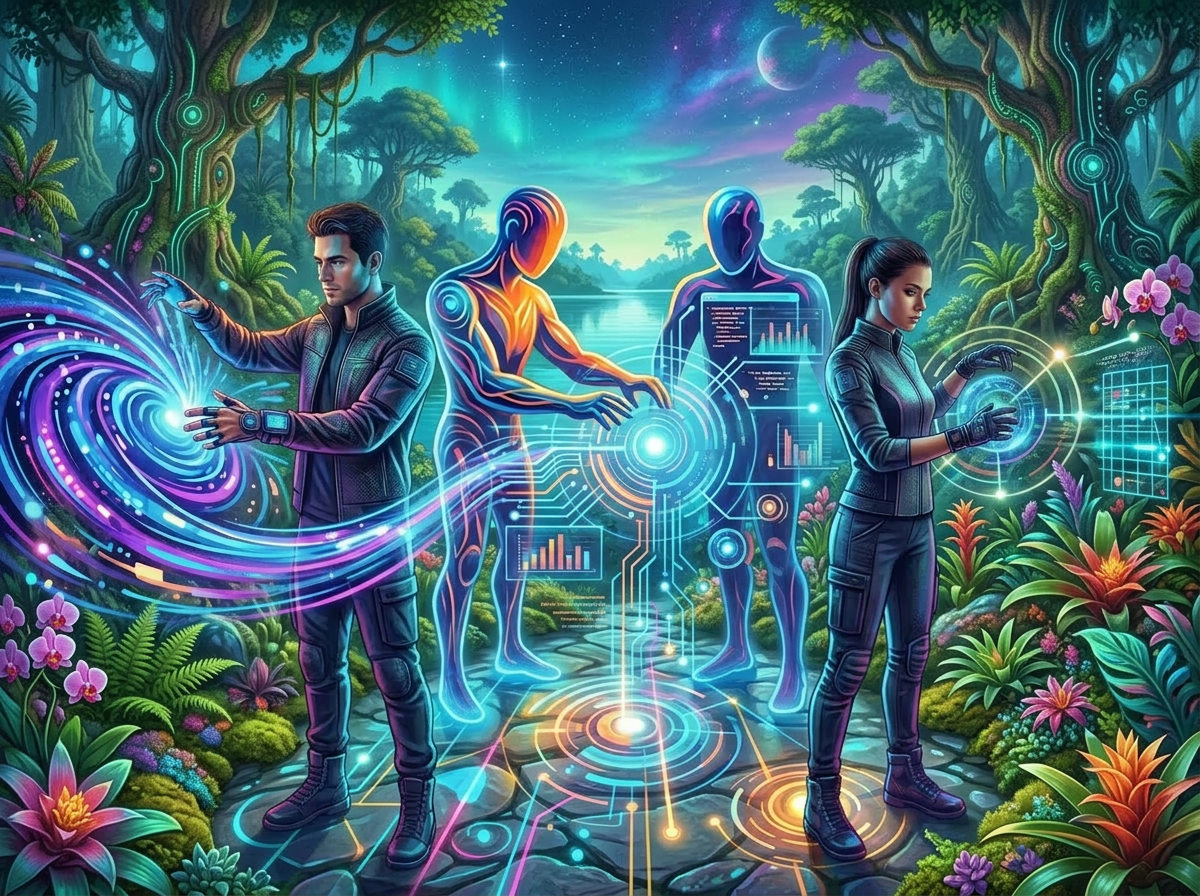
We live in a world that is more connected than ever before. Technology enables us to communicate instantly across continents, collaborate in real time, and access information at unprecedented speed. Yet many people feel increasingly disconnected from meaningful relationships and meaningful work. Organisations, too, face declining engagement, burnout, and growing challenges in retaining talent.
Perhaps one of the greatest leadership challenges of our time is not simply improving performance or strengthening relationships. It is learning how to cultivate both meaningful contribution and meaningful connection.
This is where purposefulness and empathy intersect.
Artificial Intelligence is transforming our world at an astonishing pace. Tasks that once required human expertise can now be completed in seconds. AI can analyse data, generate content, recommend solutions to complex problems, and even engage in conversations that feel remarkably human.
While these advances offer tremendous opportunities, they also present a profound question: as machines become increasingly intelligent, how do we remain deeply human?
The greatest risk of AI may not be the loss of jobs or the disruption of industries. It may be the gradual erosion of the very qualities that make us human. As we become accustomed to outsourcing our analysis, thinking, decision-making, and even aspects of our relationships to technology, there is a danger that efficiency begins to replace wisdom, convenience begins to replace effort, and information begins to replace understanding.
Yet, when viewed through the lens of purposefulness, we see that the more capable AI becomes, the more valuable uniquely human capacities become.
One of these capacities is judgement. AI can process vast amounts of information, but it cannot fully understand psychosocial contexts, emotions, values, ethics, or the consequences of decisions in the way humans can. Much of this knowledge is unique to each individual and is shaped by lived experience rather than stored in a data centre. In an increasingly complex world, the ability to exercise sound judgement will become far more important than simply possessing information.
Wherever we look today, the world is accelerating towards a digital future.
Artificial intelligence is transforming how we work. Governments are digitising public services. Businesses are automating processes at an unprecedented pace. Schools and universities are preparing students for careers that did not exist a decade ago. Across industries and nations, digital transformation has become synonymous with progress.
The benefits are undeniable. Technology has enabled us to communicate instantly across continents, access knowledge at extraordinary speed, improve productivity and solve problems that once seemed insurmountable.
Yet amidst this progress, I find myself reflecting on a deeper question.
As we become more digital, are we becoming less human?