
Start with the Self (Purposeful Leadership – Part 3)

Purposeful leadership starts with the purposefulness of the individual holding the leadership role. How can a purposeless individual help people and organisations to be purposeful? I am not claiming that all leaders are purposeful self-leaders. Many are not, and as a result, the people and businesses are not purposeful. In this article, we explore the notion of purposeful self-leadership. Given the need to keep these articles short, we will explore how to develop purposeful self-leadership and the complexities of such an aspiration in subsequent articles. In the first two articles of this series, we explored the two keywords of the concept of purposeful leadership: purposefulness and leadership and the three branches of purposeful leadership: self, people and organisations.

A useful question to ask at the outset is what is purposefulness and how do we know we are purposeful?

Continue reading “Start with the Self (Purposeful Leadership – Part 3)”

Saying ‘Yes’ to Beingness

An original poem by Ranjan De Silva

Image credits: goodmorninggratitude.com


Beingness invites us to ‘be’

But we attempt to ‘become’

Are we human beings or human becoming’s?

What would it mean to just be?

Continue reading “Saying ‘Yes’ to Beingness”

The Moral Foundation of Value

“The first principles of value that we need to rediscover is this: that all really hinges on moral foundations. In other words, that this is a moral universe, and that there are moral laws of the universe just as abiding as the physical laws” – Marting Lucher King Jr.

The importance of value for organisational and personal purpose came into my radar about 25 years ago when I was in the mid thirties in age. I have incorporated this notion in my leadership development practice in developing leaders and helping them transform organisations. As I started inquiring in to this notion as a part of my doctoral studies a few years ago, having learnt to look at things critically from different paradigms, I realised the complexity of the notion of ‘values’.

Continue reading “The Moral Foundation of Value”

Your Children Are Not Your Children

When I first read these lines in the ‘Road Less Travelled’ by M.Scott Peck, quoted from the original writings of Khalil Gibran, I was confused. What are you saying? My children are my children, I gave birth to them and I did what it takes to grow them in to purposeful adults. However, after listening to it and reflecting on it, I realised how profound these words were. I have created a video with these words of wisdom as you see embedded in this blog. I recommend you watch and listen to the words in the video, reflect on it and then read the rest of the blog.

I believe the impact this video creates is different from person to person. I also believe the impact this video creates for you is determined by the journey of your life so far, where you are in your life now and your aspirations for the journey ahead. Therefore I feel the best contribution I can make is to write about what this poem means to me. Perhaps that might give you another perspective for you to reflect on, perhaps nourish your perspective and move you on to further reflection.

Let me reflect on the verse in two parts;

Continue reading “Your Children Are Not Your Children”

When We Judge a Book by the Cover!

I Dreamed A Dream by Susan Boyle

An amazing perforce that stunned the audience and judges at Britains Got Talent.

Reflection Guide:

As you watch this video, think of the times that you have pre-judged someone by your initial perception. How many time have they surprised you with the real substance in them. Reflect on times that you had been in the receiving end. What learnings do you take from the reflection and what steps would you take to change your attitude and help other change their attitude.

Songs for Growth

Philosophies That Drive Us

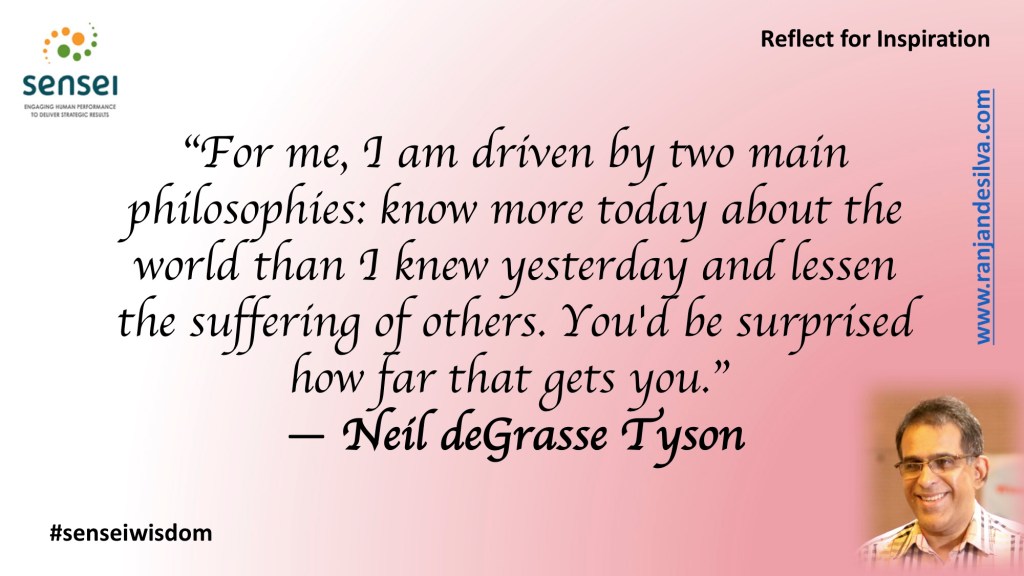
For Neil deGrasse Tyson, its increasing knowledge and reducing suffering daily, that drives hime? Reflect on what drives you everyday.

How You Lived Will Epitomise Your Death

How Did You Die? – Edmund Vance Cooke

Reflect on the deeper meaning of this poem as you listen to it and read the lyrics below. How did you respond to trouble times? What did you do when you fell down? What is real success & failure? How would you face life’s challenges from now onwards?

Read by Shane Morris – Full Poem:

Did you tackle that trouble that came your way

With a resolute heart and cheerful?

Or hide your face from the light of day

With a craven soul and fearful? 

Oh, a trouble’s a ton, or a trouble’s an ounce,

Or a trouble is what you make it,

And it isn’t the fact that you’re hurt that counts,

But only how did you take it? 

You are beaten to earth?

Well, well, what’s that!Come up with a smiling face.

It’s nothing against you to fall down flat,

But to lie there-that’s disgrace. 

The harder you’re thrown, why the higher you bounce

Be proud of your blackened eye!

It isn’t the fact that you’re licked that counts;

It’s how did you fight-and why? 

And though you be done to the death, what then?

If you battled the best you could,

If you played your part in the world of men,

Why, the Critic will call it good. 

Death comes with a crawl, or comes with a pounce,

And whether he’s slow or spry,

It isn’t the fact that you’re dead that counts,

But only how did you die?

Liberating Empathy

Can empathy be developed or Liberated? As you watch this video, reflect on this questions. Consider how important empathy is for leadership success. Is there an ideal amount of empathy? Could empathy be too much or two little? What steps would you take to liberate the ideal amount of empathy from within you for your leadership success.

The following process can be used to create a learning experience for your team using this video.

Step 1 – A moderator (an expert from your company) to open the session, explaining the importance of the session.

Step 2 – Show the video – let participants absorb, take notes and write down questions to ask later

Step 3 – Have a Q&A session and a discussion

Step 4 – Agree on actions to be taken based on the video

Step 5 – Participants to say how the session was useful.

Living Life To The Fullest as the Captain of Your Life

O Captain Mu Captain – Walt Whitman

Reflect on the deeper meaning of this poem as you listen to it and read the lyrics below. Who is the captain of your life? How will you live to be able to be happy on your last day feeling that that you lived it all.

O Captain, my Captain our fearful trip is done
The ship has weathered every rack, the prize we sought is won
The port is near, the bells I hear, the people are exulting,  
While follow eyes the steady keel, the vessel grim and daring  
But O heart! heart! heart!  
O the bleeding drops of red,  
Where on the deck my Captain lies,  
Fallen cold and dead.  

O Captain, my Captain (x3)

O Captain, my Captain rise up and hear the bells  
Rise up—for you the flag is flung—for you the bugle trills
For you bouquets and ribboned wreaths—for you the shores a-crowding  
For you they call (the swaying mass)
their eager faces turning (their eager faces turning)
Here Captain! dear father!  
This arm beneath your head  
It is some dream that on the deck, 
You’ve fallen cold and dead. Dead.

My Captain does not answer, his lips are pale and still  
My father does not feel my arm, he has no pulse nor will  
The ship is anchored safe and sound, its voyage closed and done  
From fearful trip, the victor ship, comes in with this object won
Exult, O shores, and ring, O bells!  
But I, with mournful tread,  
Walk the deck my Captain lies,  
Fallen cold and dead. Fallen cold and dead.