There is a compelling seduction in goal setting. A tidy metric. A date on the calendar. A trophy on the shelf. Goals promise clarity and certainty in a complicated world. Yet, as I have often observed in leadership work and personal reflection, the same mechanism that energises performance can also distort judgement, corrode relationships, and narrow our field of vision until only the finish line seems to matter.
This is the problem with goals; not that they exist, but that they so easily become all that exists.
When organisations get obsessed with goals, people begin to feel the heat of retribution and repercussions. Meeting the number eclipses meeting the need. Targets become a test of capability rather than a tool for learning. Under pressure, talented individuals often drift into unhealthy competition and, at times, resort to unethical means. Collaboration gives way to territorialism. Short-term wins get overvalued; long-term consequences get discounted. Leaders unwittingly convert their teams into anxiety machines, characterised by being busy, brittle, and perpetually braced for impact.
In the first article of this series, published last month, we explored the two keywords of the concept of purposeful leadership: purposefulness and leadership. As I mentioned earlier, I allow the series to unfold as in the process of finding purposefulness. Being purposeful means creating a positive impact on the people and environment one encounters (De Silva, 2024). As I reflected on this series, the idea of writing about the three branches of purposeful leadership emerged.
I use the metaphor of ‘branches’ rather than categories, boxes, or containers because I see the three core areas of purposeful leadership growing in unison, but at different speeds and proportions, much like the branches of a tree. The bigger branches grow stronger but perhaps more slowly, while the smaller branches grow faster but are not as strong. However, all branches, big or small, have a purpose in the growth of the tree.
Today’s learning video is for Customer Service and Sales Professionals at all levels.
Mindfulness Based Customer Service by Tanzi Usoof
Learn how to provide better customer service by using mindfulness practices. This is a skill which is even more important during times of anxiety when your mind is full. Learn how to empty your mind of the anxiety, worry, clutter etc. so that you can fully focus on the customer with the intention of being of service to the customers.
I hope this could be useful in providing online learning to your team members, family, friends and self during the current down time so that they would be kept positive, motivated and sharp so that all of you would be geared to perform with excellence during the crisis and after.
Today’s Soul Nourishing Poem is: Little Cloud – recited by Eric Carle
I am pleased to provide you a series of videos containing soul nourishing poems. There will be one every other day for the next few weeks.
I hope this could be useful in nourishing your soul with hope, aspiration, positivity and confidence to deal with the present and gear up for the future.
Please feel free to share this poem with others who can benefit and communicate with me if you would like to share your thoughts.
Today’s learning video is for employees at all levels.
Fight Covid-19 – 7 Simple Steps (7.35 mts.)
A 7 minute video with 7 tips on how to deal with the present and gear for the future.
I hope this could be useful in providing online learning to your team members, family, friends and self during the current down time so that they would be kept positive, motivated and sharp so that all of you would be geared to perform with excellence during the crisis and after.
I have learnt that we keep discovering our higher purpose as we live life once we discover the notion of purpose and is conscious of its existence. This had got me in to the habit of reflecting, reviewing, refreshing and re-writing my purpose every month.
The first part of my current purpose statement is;
Inspire others to live a purposeful life based on their own evolving beliefs, values and methods.
This is based on my discovery of how my beliefs, values and methods evolved during my first-person inquiry and my discovery of how different people have different beliefs, values and methods that evolve as they attempt to live purposefully, during my second-person inquiry. First- and second-person inquiry are methods of action research that I adopt in my doctoral research into the notion of ‘purposeful living’. Continue reading “Take a JUMP in to your purpose – Purpose of Living – Part 36”→
Have you ever faced a situation where you have a purpose that clashes with the purpose of a colleague, such as your boss, peer or a direct report? Has this situation led to misunderstandings, arguments, anger, click formation, politicking and even violence that starts affecting the business of the organisation? How did you handle the situation? Has it made you become disgruntled about the notion of ‘purposeful living’ and even resulted in discouraging team members in living purposefully. I will try to address this issue in this blog post from the experience I have had in dealing with such situations as a team member from within the organisation or as a consultant and coach from outside the organisation. Continue reading “When purposes clash at the workplace – Purpose of Living – Part 25”→
We explored the notion of purpose from various viewpoints in the first ten blog posts in this series. We then started making sense of our purpose in the next nine blog posts. I invite you to now reflect on the eighth aspect in the model of purposeful living– Learning & Growing; the bronze colour circle in the model. While this is the eighth circle, in real life it can happen anywhere in the nine circle process, it’s not necessarily chronological. Learning and growth that occurs due to an experience could make us feel fully alive and of service to the world and this can make us reflect and find purpose. Continue reading “Purpose of Living – Part 20: Learning & Growing as we Struggle to be Purposeful”→
We explored the notion of purpose from various viewpoints in the first ten blog posts in this series. We then started making sense of our purpose in the next eight blog posts. I invite you to now reflect on the seventh aspect in the model of purposeful living– Responding (the dark green colour circle in the model). While this is the seventh circle, in real life it can happen anywhere in the nine circles, it’s not necessarily chronological. An opportunity received could make someone feel fully alive and of service to the world and this can make him/her reflect and find purpose.
This blog-post deals with responding to the opportunities provided to us from the universe. I use the word universe to describe the energy system, a higher power that makes this planet tick. Those who are religious would make sense of this higher power as God, Allah or the Almighty. Whatever we call this power, I feel we are not intelligent enough to understand this higher power and it requires faith or a brilliant scientific mind. I believe the opportunities can come our way or we can go looking for the opportunities. Continue reading “Purpose of Living – Part 19: Responding to the Universe”→
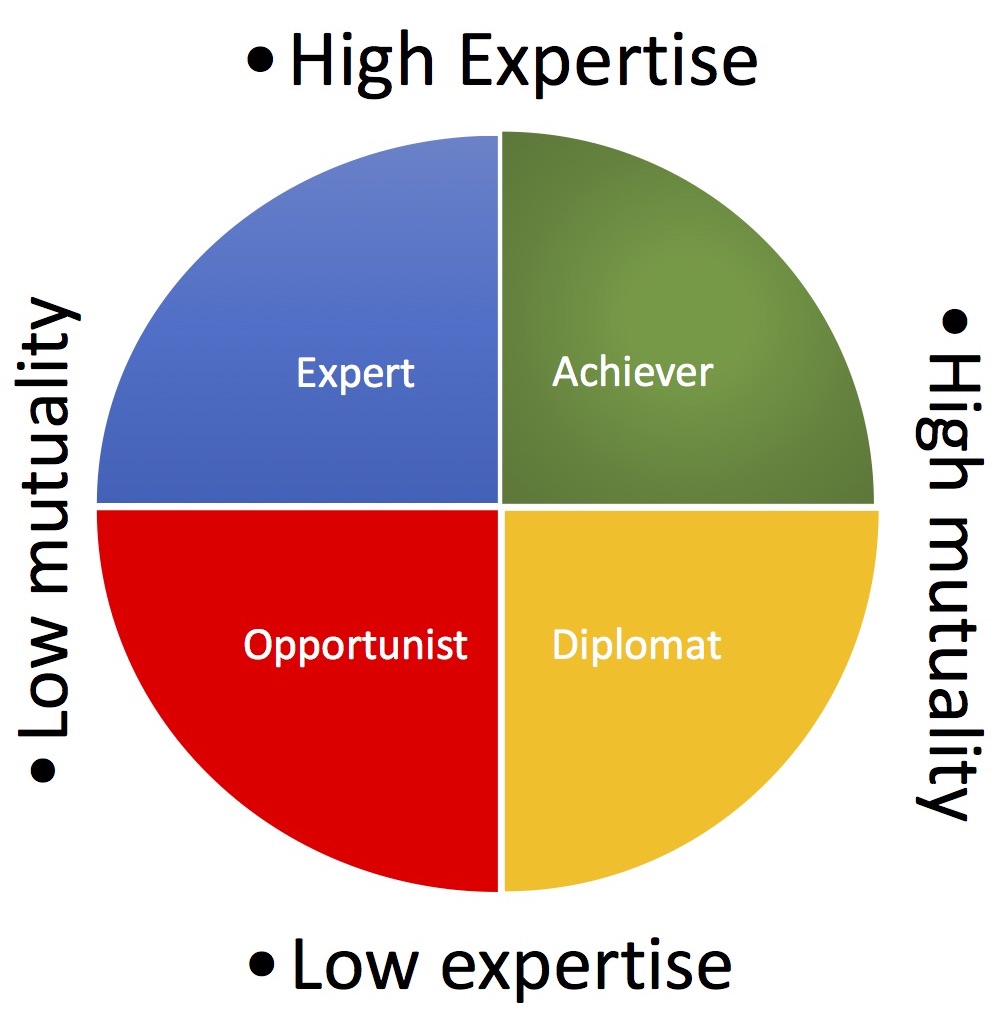
We explored the notion of purpose from the viewpoints of Abrahamic Religions, Eastern Philosophies, Early Sciences, Modern Sciences, Philosophy, Psychology & Ecology in the last few blog posts in this series. Let’s now have a look at this notion from an ‘Action Logics (pre-conventional)’ viewpoint.
Let’s first try to understand the notion of ‘Action Logics’. It tries to explain the ‘logic’ behind the ‘action’ we take. Most action is based on decisions unless it is spontaneous. If decisions are well thought out and rational, they could be based on an intention, reason or purpose. This shows that actions can be based on a reason or purpose.
Therefore, the logic behind decisions we make that determine actions we take, could have an impact on the quality of the decision and the resultant action. The notion of action logics[1] has some potential in understanding this phenomenon.
The developers of the ‘Action Logics’ model proposes two broad categories of Action Logics: pre-conventional and post conventional. According to a research study in the USA of 4300 plus adults, it was found that 85% belong to the pre-conventional group. While it is difficult to define pre-conventional, to me it seems like those who are more materialistic, achievement oriented, less mature, younger and competitive would fall in to this group. Let me try to make sense of the four pre-conventional ‘Action-Logics’ in relation to purposeful living. Continue reading “Purpose of Living – Part 9: The Action Logics (pre-conventional) Viewpoint”→
2016 is almost over and I hope you made good progress during the year. Some of us would say it was an awesome year, some would say it was an average year and some others would say it was not a good year! The best we can do is to use the learning from 2016 so that we can make 2017 a better one.
I am pleased to present a simple four-step process to help you prepare for a fruitful 2017.
Step 1: Let’s start by doing this simple reflective exercise to take the resources from 2016 for a better 2017. Answer the following question in writing or in an artful form such as a picture, poem, collage, structure etc.
What were my biggest successes in 2016? What did I learn from it?
What were my biggest failures in 2016? What did I learn from it?
Who am I grateful for 2016? (Those who helped me and was tough on me)
Let’s first try to understand what is ‘Natural-ability’ before trying to understand what your Natural-ability is and how to use this potent idea in improving your effectiveness individually and as a team.
Natural-Ability is a description for a level of ability. To simplify it let me offer four broad levels of ability. At the bottom is ‘Inability’, where we just can’t do a particular task. The next level is ‘Learnt-ability’, where we can do a particular task. The third level is, ‘Excellent’ where we not only can do a particular task, but we can do it well. We can get up to ‘Excellent’ level through training and developing our skills. But to get to the fourth level, ‘Natural-ability’ we would not only be really good at doing a particular task, but we are passionate about, it energizes us and it inspires others. It is simply something natural in us. Therefore I believe we cannot get to the level of Natural-ability by training ourselves, it should be within us. It is a word used to describe your natural strengths. It also highlights your responsibility to put your talents to work for the shared purposes of those with whom you make a commitment of this tremendous energy.
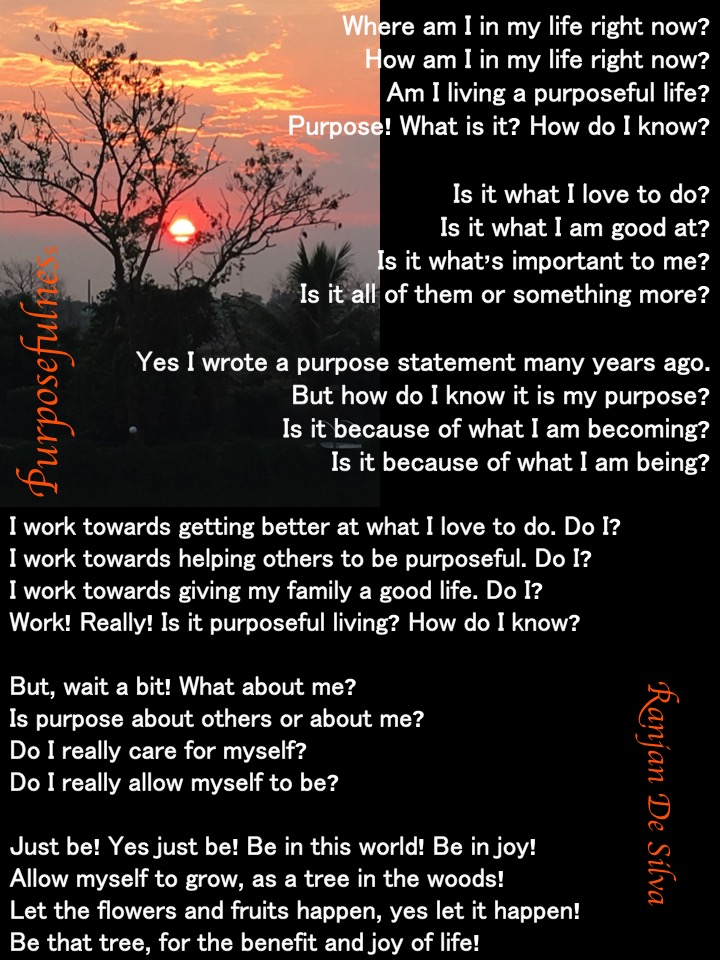
Have you ever wondered about the purpose of your life? Why on earth are you here? Those of you who may have been to one of our workshops or any other relevant learning experience, may have an idea about the concept of purpose and know at least the beginnings of your purpose. Given below is a poem I wrote as I reflected on where I am with regard to my purpose, together with a group of us who are co-inquiring about our purposefulness.
I recommend you do some creative journaling about where you are with regard to your purpose using a poem, song, photo, drawing, pottery, mask, handicraft, dance, writing, mind map, formula, graph or any other form you are most passionate about to understand about your current purposefulness. Please share them with us if you wish, we would love to see them and help you make sense of it.
The photo of the tree in the picture that includes the poem above inspired me to write this poem.
We examined why we do what we do from the Action Logic framework Introduced by Greuter Cooke (Cooke 2002) where we discussed the four pre-conventional action logics; opportunist, diplomat, expert and achiever. Click here to read the previous blog. This paper takes us to the post-conventional action logics; Individualist, Strategist, Alchemist and Ironist.
We need to remember that only about 15% of adult population, based on research done on a sample of adults in the United States, operate with post-conventional action logics. I suspect the percentage may not be too different in other parts of the world, but I feel the percentage may be higher in the east (countries around India and China) due to the long history of mindfulness practices such as meditation, yoga etc. that we adopt. It is also important to note that those in lower action logics may find it difficult to relate to and practice higher action logics, but those operating in higher action logics, finds it easy to relate to and operate in lower action logics as required.
Since the transition from pre-conventional action logic, let’s go back to the example of Sara, I wrote about in my earlier blog, who transitioned from a ‘expert’ action logic and learnt how to listen, take feedback and discuss different options presented by her colleagues. This approach not only helped her to make better decisions, as she is richer in perspectives, it has also strengthened her relationships with her colleagues.
We are one of seven billion people in this world and each one of us sees the world from our own paradigm. This short blog post will examine the dangers of getting imprisoned in a paradigm and the benefits of becoming a prism as prisons are restricting and prisms are reflecting.
For example, when it comes to a decision of buying a family car, each family member would look at the decision from a different paradigm. The father might look at technical performance and fuel efficiency, the mother might look at the spaciousness and colour scheme, the teenage son might look at how classy it looks and how fast it can go and the teenage daughter may not care about any of this. When each family gets prisoned in their paradigm, they will not be able to come out of it to look at the decision from other paradigms, leading to possible misunderstandings, conflicts and even permanent damage to the quality of relationships.
Therefore the question is, how do we get out of the paradigm prison?
What makes a difference between an ordinary leader and an extra ordinary leader?
While there could be many reasons for this difference, I would like to propose the idea of ‘Purpose’.
I remember the time where I was responsible for business results in a company before I found my purpose. My primary focus is to achieve profit target of the company. This was pursuing a goal set by my company; it was not even a purpose. My life was about going to work every day, making decisions on how best to be better than competitors and using (yes using them without thinking of their growth & welfare) the people allocated to me in achieving these goals. Unknowingly I was neglecting my health, spirituality, my relationships, my financial health and I was squandering my time. I remember those days where I was hospitalized with stress attacks, struggling to pay my bills, gaining weight and working long hours. Fortunately I had a drive to educate myself, perhaps to overcome the fear of financial challenges and the passion to spend time with my children, perhaps because blood is thicker than water and, as they were such adorable children.
My life changed when I was fortunate enough to write a purpose during the first Mastery of Self playshop I attended. What was powerful about the purpose was it helped me to know myself deeper and to see the life I am designed to live. Formulating a realistic five year and Continue reading “Power of Purpose for Leadership Success!”→
I remember the time I used to be so enthusiastic about a new year and formulate an exciting plan. However after a few months there is disappointment realizing that I had made only insignificant progress in executing the plan.
Over the years I have formulated and refined a method of ensuring my plans get achieved by carrying out a month end (or next month beginning) booster and I would like to share it with you. As I always say, just because this worked for me, there is no guarantee it will work for you. Therefore I invite you to try this out and adjust it to suit your situation so that it works for you.
We are born as passionate beings and somewhere down the line some of us started seeing the diminishing or absence of that passion. This piece of writing will attempt to identify the reasons for the diminishing of passion, the role we play in killing passion and what role can we play to ignite that passion. I have found that using the energy within the hearts and minds of our teams by igniting their passion as one of the most productive and cost effective ways of driving performance.
Reflecting on our childhood where we had all the energy to live life will confirm this. Observe a baby showing the need for affection with her passionate cry for attention. Observe children passionate about playing the games they love to play. Observe children passionately asking for the toy of their choice from their parents. We also carry this passion to our adulthood in areas that are important to us. Observe a young man passionately pursuing to foster a relationship with the woman of his dreams. Observe a musician singing his heart out entertaining his fans. Observe and entrepreneur passionately promoting his business.
Let’s make 2016 an awesome year! Trust you have already done the two activities recommended in my blog in taking the best of 2015 to make the best of 2016. Having done that would help in making this activity even more powerful. The first blog is about doing a gratitude list; people and happenings durign the year that you are grateful for. This activity makes us generate the positive energy required to gear up for the new year. See more details about this activity following this link. The second blog is about taking stock of 2015. See more details about this activity following this link. However if you are short of time you may do the activity in this blog post as a stand-alone activity and make a note to re-visit the earlier two activities if time permits.
We prepare our mind for success and failure based on how we programme, condition and prepares it. A positive mind will activate the ‘Reticular Activating System’ [RAS] to experience [see, hear, feel, smell, taste] positive situations if we are looking for it and open to it. Therefore if you are looking for the ideal ‘Masters Degree’ to pursue in 2016, once you see, hear and feel yourself enjoying pursuing the masters degree successfully in your mind, your brain will filter and pick up ides for the ‘Masters Degree’ from the millions of stimuli bombarding us every second of our life.
Gearing up for an awesome 2016
Given below are two processes. The first process will help you come up with an inspirational plan. The second is to take steps in implementing the plan. Given below are the steps in coming up with the inspirational plan; this can be done individually, with your family or with your team.
Step 1: List down three big goals you [or your family or your team] would like to achieve in 2016.
We don’t get what we expect, we get what we inspect! Things that are evaluated get elevated! Therefore measuring team effectiveness and taking improvement actions based on the feedback is an essential aspect of creating great teams.
In my blog post on the 7th of May 2014 titled ‘How great is your team?’ I promised to go into details of the 11 different aspects that make a great team. The first ten aspects regarding Burning Platforms, Team Alignment Around Critical Goals, Clearly Agreed Way of Working, A Great Decision Making Process, Information Flow is Encouraged, Great Leaders Don’t Mince Their Words’, Positive Crisis, Great Conversations, Radical Conversations and Regular Team Activities, have already been posted in this blog (please search this website to find the earlier instalments). Here is the Eleventh and final installment, Team Evaluations.
In my blog post on the 7th of May 2014 titled ‘How great is your team?’ I promised to go into details of the 11 different aspects that make a great team. The first nine aspects regarding Burning Platforms, Team Alignment Around Critical Goals, Clearly Agreed Way of Working, A Great Decision Making Process, Information Flow is Encouraged, Great Leaders Don’t Mince Their Words’, Positive Crisis, Great Conversations, and Radical Conversations, have already been posted in this blog. Here is the Tenth installment; Team Learning.
Team’s, who learn together, stick closer and work better. While we learn every moment of our life, including when at work, great teams have planned processes to create that learning inside and outside the workplace.
In my blog post on the 7th of May 2014 titled ‘How great is your team?’ I promised to go into details of the 11 different aspects that make a great team. The first eight aspects regarding ‘Burning Platforms’, ‘Team alignment around critical goals’, ‘Clearly agreed way of working?’ ‘A great decision making process’, ‘Information flow is encouraged’, ‘Great leaders don’t mince their words’, ‘Positive Crisis’ and ‘ Great Conversations’ have already been posted in this blog. Here is the ninth installment; ‘Radical Action Conversation’.
Radical Action Conversations are authentic. They go beneath the surface and deals with ‘adaptive’ issues that hinders real execution. Such conversations deals with engagement issues, honesty issues, relationship issues etc. that people may generally try to avoid to maintain false harmony. It encourages team members to be in ‘Adult’ mode rather than ‘Parent’ or ‘Child’ mode as described in ‘Transactional Analysis’. Such conversations are about identifying and dealing with assumptions team members make in their decisions, prejudices, actions, relationships etc.
Consider this. Your organization is working on a product launch that requires coordination between planning, manufacturing, marketing, sales, legal, finance and supply chain teams. The project is running late and at the current speed the launch could be delayed by more than 2 months. This can give a major advantage to the competitors who are working on a similar product to meet the same need of the customer.
The discussions at the management meetings are very technical. They speaks about the delay in finding the right raw materiel, delay in gearing up distributors and delay in configuring machines in the factory. The team discusses this and decides on some steps to speed up, but the situation is the same at the next meeting. The team resorts to unproductive conversations such as fake, dormant and aggressive conversations to avoid facing the real issues. See my blog post ‘Great Conversations’ for more details of unproductive conversations.
This becomes a radical conversation when the team starts talking about the adaptive aspects such as the trust issues between the marketing and sales manager, the integrity concerns of the supply chain manager and the competency concerns of the factory manager. The team starts focusing on facts, when the focus changes to transforming rather than debating reality, when there is willingness to challenge and explore assumptions, when tough decisions are made based on these conversations and when clarity of accountabilities and commitments are achieved. Discussions at future meetings focus on tracking actions decided, agreeing on course corrections required and ensuring execution with both discipline and speed.
Such Radical Action Conversations will see relationships growing rather than cliques being fostered and team capability clearly growing through the engagement. Radical Action Conversations requires skill and courage and it takes a lot of effort to develop team with this capability. However this is not just useful but essential for a great team!
Remember the last time you were engrossed in a conversation? Conversation where real issues were discussed! Conversations that were authentic! Conversations that were value adding! Conversations that made time stand still! Conversations that made things happen! Conversations that got continued! These are the conversations that make great teams.
In my blog post on the 7th of May 2014 titled ‘How Great is Your Team?’ I promised to go into details of the 11 different aspects that make a great team. The first seven aspects regarding ‘Burning Platforms’, ‘Team Alignment Around Critical Goals’, ‘Does your Team have Clearly Agreed way of Working?’ ‘A Great Decision-Making Process for a Great Team’, ‘Information Flow is Encouraged’, ‘Great Leaders don’t Mince their Words’ and ‘Positive Crisis’ have already been posted in this blog. Here is the 8th installment regarding the 8th aspect; ‘Great Conversation’.
Have you ever wondered what makes a movie interesting? It is the crisis in the movie, even when it is a comedy or an animated children’s film there is some crisis and you will realise how boring that movie could be without that crisis. Similarly meetings become interesting when there is a crisis to deal with. A project becomes interesting when there is a crisis to deal with. A team becomes interesting when there is crisis between team members.
In my blog post on the 7th of May 2014 titled ‘How great is your team?’ I promised to go into details of the 11 different aspects that make a great team. The first six aspects regarding ‘Burning Platforms’, ‘Team Alignment around Critical Goals’, ‘Does Your Team have Clearly Agreed Way of Working?’, ‘A Great Decision-Making Process for a Great Team’, ‘Information Flow is Encouraged’, and ‘Great Leaders don’t Mince their Words’ have already been posted in this blog. Here is the seventh instalment regarding the 7th aspect; ‘Positive Crisis’.
We love to hear good news! When bad news comes our way some times we tend to get upset, our body language and tonality shows that we are not pleased with the information and some resort to further unproductive behavior of shooting the messenger! Shooting the messenger can be in many forms. Some would question the messenger and ask them to justify the information. Some others may ridicule them as being negative or incompetent. Some others may even resort to retribution in the form of impacting their rewards and recognition negatively. However great teams have great leaders who behave positively and encourage information flow! In my blog post on the 7th of May 2014 titled ‘How Great is Your Team?’ I promised to go into details of the 11 different aspects that make a great team. The first four aspects regarding ‘Burning Platforms’, ‘Team alignment around critical goals’, ‘Does your team have clearly agreed way of working?’ and ‘A great decision-making process for a great team’ have already been posted in this blog. Here is the fifth installment regarding the 5th aspect; ‘Information flow is encouraged’. Great information flow requires the following mind-set, thinking and behaviours; Continue reading “Great Information Flow to Make Your Team Fly!”→
Do you generally find that your email inbox clogged with unattended mail?
Do you find that there are many important things to attended to?
Do you find that some important projects don’t get your required attention?
Do you find that some important task are neglected or delayed?
Do you feel that there are some task that you need to attend but you get drained trying to do them?
Do you find you just don’t have enough time to do tasks you enjoy doing that energizes you?
Well, if the answer to one or many of these questions are yes, then many of the answers are with David Allen, the author of many books including, ‘Getting Things Done’ and inspirational speaker.
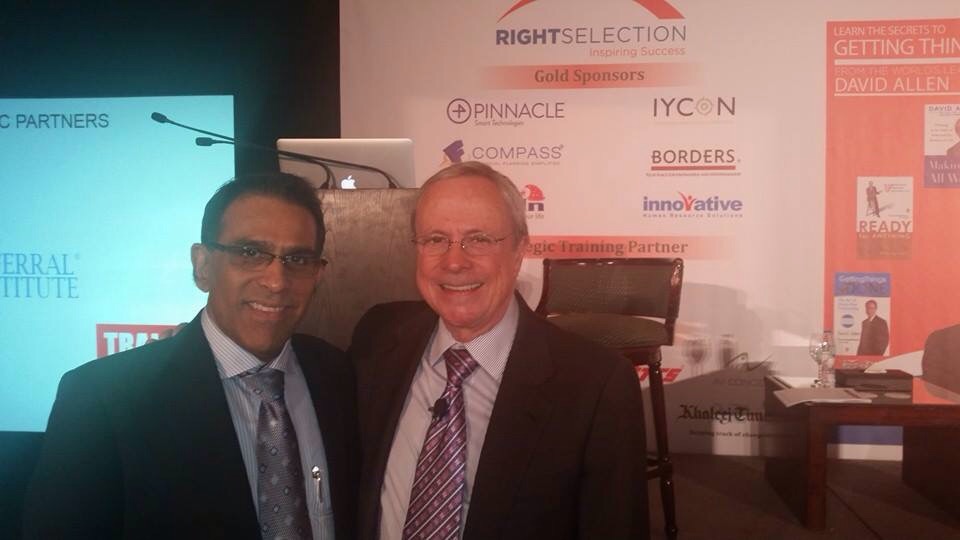
I was fortunate to be at David’s session today, organized by Right Selection, the company who also represents me in the Middle East. While I generally have an empty email inbox, have things quite well organized with most things done by the end of each week with, and adequate time to do things I am passionate about, I found David helps put things in perspective and provides concepts and a process that helps get things done.
The concept of ‘The Burning Platform’ was first introduced by Daryl Conner who used the metaphor of an Oil Rig worker who had to leap into the water to save himself when the platform of the rig was burning. In this situation if the worker did not jump there was certain death as he would have got burned on the platform and jumping into the heated water with debris was possible death if he was not rescued within 20 mts. So he took the call based on the odds of saving his life although both options he had had a high risk of death. What he essentially tries to say is that sometimes we need to take a call in a hopeless situation such as a burning platform and such a call can ignite and motivate us to unite as a team and do the impossible.
Therefore counties unify when there is a burning platform. A historic example is Japan after world war 2. Similarly there are many examples of people uniting when there had been a suicide bomb attack, sports teams uniting after a heavy defeat, companies uniting when competitors launch a game changing product etc.
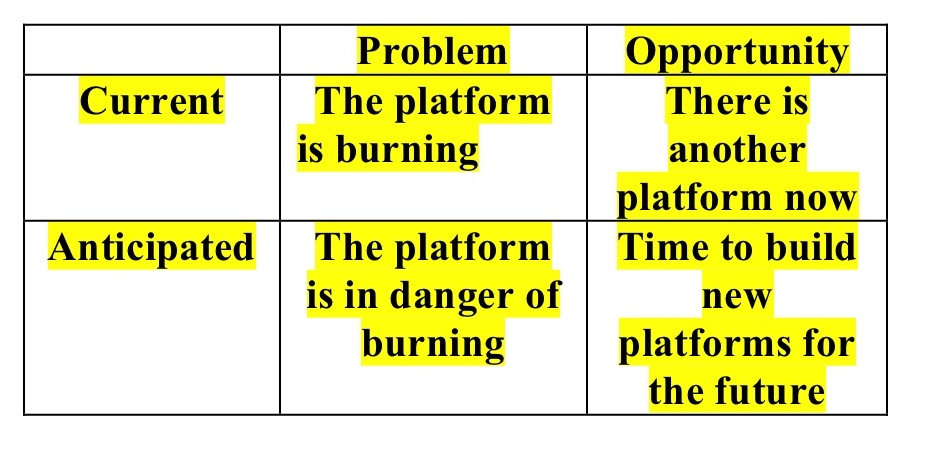
However the concept of burning platforms, if taken literally can be misunderstood to mean that a team needs a disaster to unite. There are 4 Types of burning platforms as shown in the following matrix.
Lets examine each of these burning platforms;
The Platform is burning: This is a problem faced by the team in the present. This means we are in trouble and need to take immediate action. Examples of this situation are; competitor has launched a game changing product, one of our factories have been destroyed by fire, A quality issue that has put us in the danger of loosing our biggest customer, trailing 0 – 2 in a soccer game, civil commotion affecting the supply of vital raw materiel etc.
The leadership response: In this situation the leader needs to gather the entire team and collect information regarding the situation from all team members, asses the crisis quickly, show the team how it can affect each member and the team, collect ideas on how to deal with the situation, formulate a plan and assign team members to take action. Given the situation and its personal impact, the team will [at least temporarily] put aside their differences and work together to deal with the situation. This process can bring diverse team members together, generate creativity, ignite the passion and create synergy. Teams coming out of such situations are generally stronger and are geared to achieve greater results. In this situation the leaders challenge is to convert fear and confusion into confidence and hope.
Leadership is about developing team members to carryout the important responsibilities in the organization. This is essential if we are to grow and take on higher-level responsibilities. Developing team members requires time. Therefore leadership is inefficient in the short run. However it is a great investment of our time and energy to reap near medium term to long-term results, as having a developed team will help produce more value and great results.
Given below are 10 common areas where this inefficiency can happen.
Getting the right team member in to the team: We need to first ensure the team member with the right attitude and skills are recruited into the team. This requires spending time on determining the profile of the ideal team member, preparing the right evaluation techniques and spending quality time evaluate the candidates.
Taking time to direct: When a new team member is recruited or transferred in from another area of the organization to our team it takes time to induct and teach. Time needs to be allocated to introduce the new team member to the other team members, work environment, mission, vision, values, customers, products and work processes.
Listening: It is important to actively listen to the team member to understand his/her level of absorption, development, enthusiasm, motivation and concerns. This will enable us to ensure the new team member feels at home soon, ready to take on responsibilities that we are planning to delegate.
Handing over responsibility: It requires us handing over a task that may have taken us 1 hour to complete and it takes our team members double that time as he/she consciously and carefully does the job as requires. We need to have patience knowing that there is a natural curve of gaining efficiency as the skill and confidence improves.
Detailed briefing: It is important to provide a detailed briefing for the responsibilities to be delegated. It requires determining how much of authority needs to be delegated. It requires documenting the details, some of which is in our mind and we do as second nature. Sometimes we neglect to provide the finer points thinking it is common sense. Sometimes what are common senses for us is not so common for others.
Checking work done: We need to also invest time to check the progress of work and the quality of work. This requires reading weekly updates, walking into the areas of operation, speaking to those on the job, discussing variances and brainstorming solutions.
Praising: We need to lavishly praise good work. We need to praise the progress in the process, not only wait for the outcome. While this can take time, it is an important activity to reinforce good behaviour.
Improvement feedback: We need to also give improvement feedback for areas that needs to be better. Instant feedback can be detrimental as it can go packaged with negative emotions such as anger. Therefore it is better to give it some time to cool down, visualize how best to most productively provide the feedback and do so, so that this becomes an effective development activity. The cooling down periods takes time.
Dealing with demotivation of others: Delegating responsibility to one person can demotivate another team member. Therefore it takes time to keep others informed, engaged in other value adding activity and communicate consistently so that we keep the entire team motivated.
Dealing with conflict: It is quite likely for conflict to arise between team members as they work on projects and various tasks as they discharge responsibilities delegated. Therefore it is the leaders responsibility to defuse and manage the conflict to create strong team bonding. This of course takes a lot of time and the energy.
Reporting up: The leader is ultimately responsible for tasks delegated and the reporting responsibility lies with the leader. When we were doing the tasks ourselves it was easy to report in detail as we were at the thick of everything. However when it is delegated we need time to get all the details, ask questions to get clarifications and write the report.
Top Performance requires us to ensure that top teams are set up, developed, nurtured and rewarded appropriately. Most companies miss this important point. Here is a summary of the insights from the ‘Top Performance through Top Teams’ session held on the 21st of January 2014.
Inappropriate strategy deployed by the organisations to measure/improve business performance is one of the key reasons that teams remain average teams delivering average performance.
They focus too much on individuals
They focus too much on how to work than how it works (excessively process driven)
They create and run ‘Vertical Organisations’ – Hierarchies are created to fix responsibilities, which in turn dilute the authority resulting in indecisiveness / delays/non fulfilment of commitments made to all stakeholders
When an organisation faces a problem, if they have mediocre team members, they will strongly believe in maintaining/defending status-quo.
The biggest untracked cost of such companies is commitments made and not followed up.
Therefore following are the appropriate strategy for the organisations to measure/improve business performance.




 I have learnt that we keep discovering our higher purpose as we live life once we discover the notion of purpose and is conscious of its existence. This had got me in to the habit of reflecting, reviewing, refreshing and re-writing my purpose every month.





 We are one of seven billion people in this world and each one of us sees the world from our own paradigm. This short blog post will examine the dangers of getting imprisoned in a paradigm and the benefits of becoming a prism as prisons are restricting and prisms are reflecting.