Purposeful leadership is often understood as a progression: purposeful self-leadership, followed by purposeful people leadership, and eventually purposeful organisational leadership. While this sequence is a helpful entry point, it does not reflect how leadership is actually lived. In practice, purposeful leadership is not linear. It is cyclical, relational, and complex. Each form of purposeful leadership both shapes and is shaped by the others, forming a living system rather than a developmental ladder.
Purposeful self-leadership is the inner anchor of this system. It is the ongoing practice of aligning values, beliefs, intentions, and actions with a deeper sense of purpose. This inner work is not private or abstract. It shows up most clearly when leaders are under pressure, navigating ethical tension or difficult trade-offs. When leaders lack inner coherence, purpose becomes performative. When they are grounded in purposefulness, they are better able to act with integrity, resist expedient compromises, and hold responsibility with maturity.
Purposeful people leadership is where inner purpose meets relational reality. Purpose is tested not in declarations, but in conversations, decisions, and everyday interactions. The way leaders listen, build trust, address conflict, and hold accountability reveals whether purposeful self-leadership is truly embodied. Purposeful people leadership translates inner alignment into lived experience, shaping how people feel, engage, and commit to the organisation.
As we welcome 2026, many of us feel the familiar mix of gratitude, exhaustion, and anticipation. The year has given us moments we are proud of, and moments that remind us how imperfect, human and evolving we are. Before we rush into 2026, this is a valuable moment to pause, to breathe, and to reflect on how purposefully we lived in 2025.
Over the years, through the Purposeful Leadership series, I have written about the importance of aligning who we are, how the quality of our leadership begins with the quality of our inner world and how we lead. As I look back on 2025, I am reminded again that purposefulness is not a grand concept; it is a daily practice.
A simple way to explore your own experience of purposeful leadership is through three lenses: purposeful self, purposeful team, and purposeful organisation.
Purposeful leadership extends beyond the self. Once the leader becomes purposeful, the natural next step is to help others, team members, and teams become purposeful. This is not a directive process but a deeply human one, rooted in example, empathy, and engagement. In this article, we explore the second branch of purposeful leadership: leading people purposefully.
Purposefulness in people is transformative. It improves their personal lives, relationships, health, and peace of mind, and this inevitably enhances their effectiveness and contribution at work. The workplace becomes more than a place of transaction; it becomes a space of meaning. Families benefit too, as individuals carry their sense of purpose home, influencing their roles as parents, partners, and community members.
I have experienced this transformation personally. At the age of 27, I had climbed the corporate ladder rapidly to become a director of two subsidiaries of John Keells Holdings, Sri Lanka’s leading conglomerate. At the time, I was driven by ambition and the goal of professional success. I worked long hours, including weekends, and neglected many aspects of my life. I was overweight, frequently ill and hospitalised, disconnected from my young family, absent from church, and unaware of the importance of developing and empowering my team. I had no sense of purpose, only a relentless pursuit of achievement.
Everything changed when I discovered the notion of purposefulness and wrote the draft of my first purpose statement. I began going to the gym, spending quality time with my family, returning to church, reading, cutting excessive costs, investing the savings, and cultivating emotional maturity through meditation. This personal transformation awakened a desire to help my team grow. I began teaching them about purposefulness and supporting their development. As a result, my quality of life and work improved significantly. It was no longer a choice between work and life; it became a commitment to both work and life, harmoniously.
My doctoral research reinforces this understanding. As I wrote in my thesis:
“My research suggests that being purposeful helps understand life from a more holistic and altruistic manner, leads one to conduct life with decent human values, helps make choices beneficial to the flourishing of life, improves caring for the well-being of family and self, and choosing vocations which are aligned with an evolving life-purpose. Adjusting one’s lifestyle in this manner takes courage, determination, and self-discipline. However, persisting with such an aspiration leads to an improvement in the quality of life, generating happiness which, in turn, encourages persisting in being purposeful.” (De Silva, 2024)
I invite you to reflect on how you are leading people. Are you helping them become purposeful? Are you creating conditions for their flourishing? If not, what needs to change?
You may explore literature from my blog http://www.ranjandesilva.blog, my website http://www.ranjandesilva.com, and other sources. Speak with your trusted advisor. We will further explore the notion of purposeful leadership and methods of transformation in the upcoming blog posts.
In the next article of this series, we will explore how to develop purposeful people leadership, how leaders can intentionally cultivate purposefulness in others through structured development, coaching, and empowerment.
References
De Silva, R. L. G. (2024). Living Purposefully: An Inquiry into the Life of a Leadership Development Practitioner. (Doctoral dissertation, Hult Ashridge).
We explored the notion of Purposeful Self-leadership in the last post, part 3 of this series titled ‘Start with the Self’. Today we explore how to develop Purposeful Self-Leadership and in the next post, we can explore the complexities of such an aspiration. In the first two articles of this series, we explored the two key concepts of purposeful leadership: purposefulness and leadership, and the three branches of purposeful leadership: self, people, and organisations.
Developing Purposeful Self-Leadership starts with articulating a purpose statement depicting our sense of purpose at the current stage of life. The first version of the purpose statement is only a glimpse of our purpose as finding purpose is a lifelong journey. However, having a sense of purpose begins the quest and gives us the drive and desire to be purposeful. Being purposeful improves our clarity about our life purposes and helps us fine-tune our purpose statement, leading to us being more purposeful. This cyclical process not only improves our sense of purpose and purposefulness but also attracts abundance to succeed in vocations aligned with our life purpose, gives us happiness and peace of mind (De Silva, 2024).
Purposeful leadership starts with the purposefulness of the individual holding the leadership role. How can a purposeless individual help people and organisations to be purposeful? I am not claiming that all leaders are purposeful self-leaders. Many are not, and as a result, the people and businesses are not purposeful. In this article, we explore the notion of purposeful self-leadership. Given the need to keep these articles short, we will explore how to develop purposeful self-leadership and the complexities of such an aspiration in subsequent articles. In the first two articles of this series, we explored the two keywords of the concept of purposeful leadership: purposefulness and leadership and the three branches of purposeful leadership: self, people and organisations.
A useful question to ask at the outset is what is purposefulness and how do we know we are purposeful?
While trying to avoid any infections of the vulnerable is our responsibility, it is important that we do it in the most holistic and helpful manner.
Taking precautions to prevent being a conduit in spreading the virus based on social distancing and hygiene guidelines is important. This can be augmented by strengthening our immune system. Good quality and timely sleep, exercises, fresh air, nutrition and being stress free is important to keep a strong immune system.
“The first principles of value that we need to rediscover is this: that all really hinges on moral foundations. In other words, that this is a moral universe, and that there are moral laws of the universe just as abiding as the physical laws” – Marting Lucher King Jr.
The importance of value for organisational and personal purpose came into my radar about 25 years ago when I was in the mid thirties in age. I have incorporated this notion in my leadership development practice in developing leaders and helping them transform organisations. As I started inquiring in to this notion as a part of my doctoral studies a few years ago, having learnt to look at things critically from different paradigms, I realised the complexity of the notion of ‘values’.
This years Christmas present from my eldest daughter – a symbol of abundance & purpose
My new year’s message last year was ‘I wish you a new year and new decade overflowing with abundance & purposefulness’. Having gone through perhaps the most ‘interesting’ year of our life, I wonder if this wish had an impact or not. I suppose it depends on how we look at 2020. While many of us had challenges in our jobs, businesses, finances, relationships and health, it is important to reflect on and find the hidden gifts.
How time flies. We are upon the final month of 2020.
This year we learnt that plans are nice to have but our plans are so insignificant when compared to the plans of the higher powers; be it God, Universal energy system or nature.
We learn that we need to deeply understand and respond to the plans of the higher power so that we synchronise, rather than fight those plans, causing anxiety, stress and a multitude of negative behaviours.
When I first read these lines in the ‘Road Less Travelled’ by M.Scott Peck, quoted from the original writings of Khalil Gibran, I was confused. What are you saying? My children are my children, I gave birth to them and I did what it takes to grow them in to purposeful adults. However, after listening to it and reflecting on it, I realised how profound these words were. I have created a video with these words of wisdom as you see embedded in this blog. I recommend you watch and listen to the words in the video, reflect on it and then read the rest of the blog.
I believe the impact this video creates is different from person to person. I also believe the impact this video creates for you is determined by the journey of your life so far, where you are in your life now and your aspirations for the journey ahead. Therefore I feel the best contribution I can make is to write about what this poem means to me. Perhaps that might give you another perspective for you to reflect on, perhaps nourish your perspective and move you on to further reflection.
Do you really know who you are? Well, I am still discovering who I am and I am not sure if I will ever find the answer. However, everyday I live with this question in my mind, I see a little bit more of who I am.
Reflect on the basic human qualities taught by each religion and philosophy. Reflect on the extent to which we measure up to those qualities. What changes do we need before we earn the right to call ourselves Christian, Buddhist, Muslim, Hindu or any other religion or philosophy we belong to.
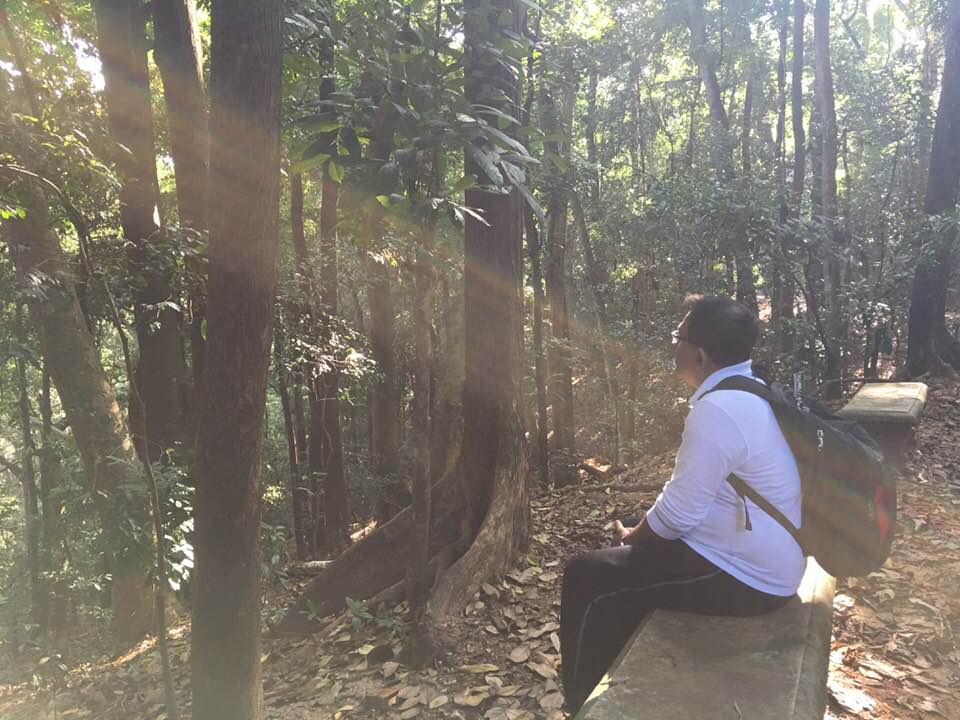
A photo taken at a rain forest in Kandy, the hill capital of Sri Lanka.
This is a photo taken during a nature walk with my team. I remember sitting down on this bench to take in the energy of the beautiful rain forest. As I reflected I felt the paradox of the place; the sounds of nature and the voices of people, the trees and the cement bench, the forest and the road, the cool wind and the warm sun rays. One of my colleagues had taken this photo at that time and I was fascinated with the rays of sunlight coming towards me, as if the universe was sending me rays of enlightenment.
An amazing perforce that stunned the audience and judges at Britains Got Talent.
Reflection Guide:
As you watch this video, think of the times that you have pre-judged someone by your initial perception. How many time have they surprised you with the real substance in them. Reflect on times that you had been in the receiving end. What learnings do you take from the reflection and what steps would you take to change your attitude and help other change their attitude.
In the one before the last blog post (two Wednesdays ago) in the ‘Purpose Quest’ series, I attempted to list down questions that came up during my various interactions with various audience over the last 6 months of the pandemic. I started attempting to write about how I responded to those question and the insights I had regarding the first two questions related to goals, in last Wednesdays blog post. Let me attempt to respond to the third questions;
What is the purpose of the pandemic? How is it serving us?
As you watch this video, reflect on your attitude towards failure, rejection and setbacks etc. What steps would you take to reinforce your attitude or change your attitude to enjoy success?
Leadership – A poem by Spatula – Read by Mathew Coger
As you listen to this poem, reflect on your current attitude about leadership. Does this move you into thinking of doing what you are doing as a leader or to change your leadership approach? What baby steps would you take to reinforce your good leadership behaviours and/or transform.
In the last blog post in the ‘Purpose Quest’ series, I attempted to list down questions that came up during my various interactions with various audience over the last 6 months of the pandemic. I will attempt to write about how I responded to those question and the insights I had, in the next few blog posts. So let’s begin with the first two questions. Both of them are related to goals;
My goals have become irrelevant due to the pandemic? What do I do now?
Why do I need to have goals when they can become irrelevant due to uncontrollable situation?
As you watch this video, reflect on your motivation (motive to take action). How does emotion (energy in motion) creates that motivation from within that helps us make a difference?
As you listen to this poem, reflect on the wonders of nature and let it heal your pensive mood or broken heart.
I Wandered Lonely as a Cloud I wandered lonely as a cloud That floats on high o’er vales and hills, When all at once I saw a crowd, A host, of golden daffodils; Beside the lake, beneath the trees, Fluttering and dancing in the breeze.
The last six month opened up amazing opportunities for me to reflect on the notion of purpose. These opportunities arose during conversations with family, team and clients in trying to make sense of the pandemic. These opportunities arose during webinars conducted to help people with their concerns, anxieties, stress and other psychological challenges. These opportunities arose from the 150 plus participants from 15 countries taking part in the four ‘Mastery of Self’ through NLP, online certificate courses over the past few months.
In this blog post I will attempt to list down the questions that came up. Some of these questions were already asked earlier, some of these are modifications to the old questions and some of these are new questions.
My goals have become irrelevant due to the pandemic? What do I do now?
Why do I need to have goals when they can become irrelevant due to uncontrollable situation?
What is the purpose of the pandemic? How is it serving us?
Is our purpose changed due to changing realities?
I am struggling more due to the pandemic. Is it helping me to find purpose?
Am I struggling more during the pandemic because I try to live purposefully?
Do our values change with situations? Arn’t they supposed to be fixed?
Isn’t values an important component of our purpose?
My purpose is clashing with the purpose of some of my family. It is prominent now because I spend a lot of time with them. How do it deal with them?
Are religious people more purposeful than non-religious people?
Does spirituality become more important than religion for purposeful people?
Does the notion of Purposeful living taken a new meaning with the pandemic?
Are world leaders being purposeful in the way they are handling the pandemic?
I will reframe from answering these questions to provide you the opportunity to reflect and answer these questions. I am not sure what that process will do. I will be delighted to hear from you the answers that came up and how these questions and answers served you.
The place which developed thousands of boys to be men of stature for over 165 year, the place I had the good fortune of being nurtured, St Anthony’s Collage in Kandy, the hill capital of Sri Lanka. The picture speaks of the nurturing location on the banks of the Mahaweli river, the space provided for sports signifying the importance of the development of the body in addition to the mind. To write about the great men produced by St Anthony’s will take a few books. All I have is gratitude for my alma mater.
As you listen to this song, reflect on those things which you believed were possible, when you were a child. Those beliefs are still embedded deep inside you. We may believe such dreams are impossible now. However the mind has amazing potential. Think of baby steps you can take today to make those dream come true.
Lyrics:
I used to think that I could not go on And life was nothing but an awful song But now I know the meaning of true love I’m leaning on the everlasting armsIf I can see it, then I can do it If I just believe it, there’s nothing to itI believe I can fly I believe I can touch the sky I think about it every night and day (Night and day) Spread my wings and fly away I believe I can soar I see me running through that open door I believe I can fly I believe I can fly I believe I can fly hooSee I was on the verge of breaking down Sometimes silence can seem so loud There are miracles in life I must achieve But first I know it starts inside of me, ho ohIf I can see it hoo, then I can be it If I just believe it, there’s nothing to itI believe I can fly I believe I can…