There is a compelling seduction in goal setting. A tidy metric. A date on the calendar. A trophy on the shelf. Goals promise clarity and certainty in a complicated world. Yet, as I have often observed in leadership work and personal reflection, the same mechanism that energises performance can also distort judgement, corrode relationships, and narrow our field of vision until only the finish line seems to matter.
This is the problem with goals; not that they exist, but that they so easily become all that exists.
When organisations get obsessed with goals, people begin to feel the heat of retribution and repercussions. Meeting the number eclipses meeting the need. Targets become a test of capability rather than a tool for learning. Under pressure, talented individuals often drift into unhealthy competition and, at times, resort to unethical means. Collaboration gives way to territorialism. Short-term wins get overvalued; long-term consequences get discounted. Leaders unwittingly convert their teams into anxiety machines, characterised by being busy, brittle, and perpetually braced for impact.
As we welcome 2026, many of us feel the familiar mix of gratitude, exhaustion, and anticipation. The year has given us moments we are proud of, and moments that remind us how imperfect, human and evolving we are. Before we rush into 2026, this is a valuable moment to pause, to breathe, and to reflect on how purposefully we lived in 2025.
Over the years, through the Purposeful Leadership series, I have written about the importance of aligning who we are, how the quality of our leadership begins with the quality of our inner world and how we lead. As I look back on 2025, I am reminded again that purposefulness is not a grand concept; it is a daily practice.
A simple way to explore your own experience of purposeful leadership is through three lenses: purposeful self, purposeful team, and purposeful organisation.
In the previous article, we explored what purposeful organisational leadership means and why it matters. In this post, we focus on how leaders can intentionally develop purposeful organisational leadership, turning purpose from a statement into a lived reality across the organisation.
Start with Leadership Commitment
“I hold the view that leaders are better able to contribute to the flourishing of life if their actions are guided by a deeper sense of purpose” (De Silva, 2024, p.6). Therefore, purposeful organisational leadership needs to begin at the top. Senior leaders must embrace the organisation’s purpose as a guiding principle for decisions and behaviours. This commitment is not symbolic; it requires courage to prioritise purpose even when short-term pressures tempt compromise.
Make the Organisational Purpose Your Guiding Light
The starting point for developing purposeful organisational leadership is a clear purpose statement. This is not a marketing slogan; it is the organisation’s reason for being and its unique contribution to the flourishing of life. From this foundation, leaders can craft a mission statement that defines how the purpose will be delivered and set Big Hairy Audacious Goals (BHAGs) to drive long-term success.
In the previous article, we explored how leaders can intentionally develop purposeful people leadership, an approach that transforms teams and organisations by aligning individual purpose with collective contribution.
While this aspiration is noble and deeply impactful, it is not without its complexities. In this post, we examine the challenges, paradoxes, and tensions that arise when we choose to lead people purposefully.
Cognitive Aspects
One of the first complexities arises from how people cognitively make sense of the notion of purposefulness. The concept of “purpose” is often misunderstood or conflated with goals. While goals are specific outcomes we strive to achieve, purpose is the deeper reason behind those goals, the “why” that gives them meaning. This distinction is not always clear, and many team members may struggle to grasp its relevance. Some may view purposefulness as abstract or philosophical, disconnected from the practical realities of work.
Moreover, individuals interpret purpose through the lens of their own experiences, beliefs, and values. What feels purposeful to one person may seem irrelevant or even threatening to another. Leaders must navigate these differences with sensitivity, helping people explore and articulate their own understanding of purpose without imposing a singular definition. This requires patience, dialogue, and a willingness to embrace ambiguity.
Purposeful leadership extends beyond the self. Once the leader becomes purposeful, the natural next step is to help others, team members, and teams become purposeful. This is not a directive process but a deeply human one, rooted in example, empathy, and engagement. In this article, we explore the second branch of purposeful leadership: leading people purposefully.
Purposefulness in people is transformative. It improves their personal lives, relationships, health, and peace of mind, and this inevitably enhances their effectiveness and contribution at work. The workplace becomes more than a place of transaction; it becomes a space of meaning. Families benefit too, as individuals carry their sense of purpose home, influencing their roles as parents, partners, and community members.
I have experienced this transformation personally. At the age of 27, I had climbed the corporate ladder rapidly to become a director of two subsidiaries of John Keells Holdings, Sri Lanka’s leading conglomerate. At the time, I was driven by ambition and the goal of professional success. I worked long hours, including weekends, and neglected many aspects of my life. I was overweight, frequently ill and hospitalised, disconnected from my young family, absent from church, and unaware of the importance of developing and empowering my team. I had no sense of purpose, only a relentless pursuit of achievement.
Everything changed when I discovered the notion of purposefulness and wrote the draft of my first purpose statement. I began going to the gym, spending quality time with my family, returning to church, reading, cutting excessive costs, investing the savings, and cultivating emotional maturity through meditation. This personal transformation awakened a desire to help my team grow. I began teaching them about purposefulness and supporting their development. As a result, my quality of life and work improved significantly. It was no longer a choice between work and life; it became a commitment to both work and life, harmoniously.
My doctoral research reinforces this understanding. As I wrote in my thesis:
“My research suggests that being purposeful helps understand life from a more holistic and altruistic manner, leads one to conduct life with decent human values, helps make choices beneficial to the flourishing of life, improves caring for the well-being of family and self, and choosing vocations which are aligned with an evolving life-purpose. Adjusting one’s lifestyle in this manner takes courage, determination, and self-discipline. However, persisting with such an aspiration leads to an improvement in the quality of life, generating happiness which, in turn, encourages persisting in being purposeful.” (De Silva, 2024)
I invite you to reflect on how you are leading people. Are you helping them become purposeful? Are you creating conditions for their flourishing? If not, what needs to change?
You may explore literature from my blog http://www.ranjandesilva.blog, my website http://www.ranjandesilva.com, and other sources. Speak with your trusted advisor. We will further explore the notion of purposeful leadership and methods of transformation in the upcoming blog posts.
In the next article of this series, we will explore how to develop purposeful people leadership, how leaders can intentionally cultivate purposefulness in others through structured development, coaching, and empowerment.
References
De Silva, R. L. G. (2024). Living Purposefully: An Inquiry into the Life of a Leadership Development Practitioner. (Doctoral dissertation, Hult Ashridge).
In the last post, we explored how to develop purposeful self-leadership by articulating a purpose statement and taking small, meaningful steps to live in alignment with it. While this process is deeply enriching, it is not without its challenges. In this post, we explore the complexities of attempting to enact purposeful self-leadership in our lives (De Silva, 2024).
Understanding the Notion of Self-Leadership
The idea of self-leadership is inspiring. It suggests that we can take charge of our lives, lead ourselves with clarity and conviction, and live in alignment with our purpose. However, understanding this notion deeply can be complex. Many mix purpose with goals when in fact it is not. A goal becomes more meaningful when it is based on a purpose. It requires us to accept responsibility for our thoughts, emotions, and actions—something that can feel both empowering and intimidating. The concept may seem abstract or idealistic, especially when life feels uncertain or overwhelming.
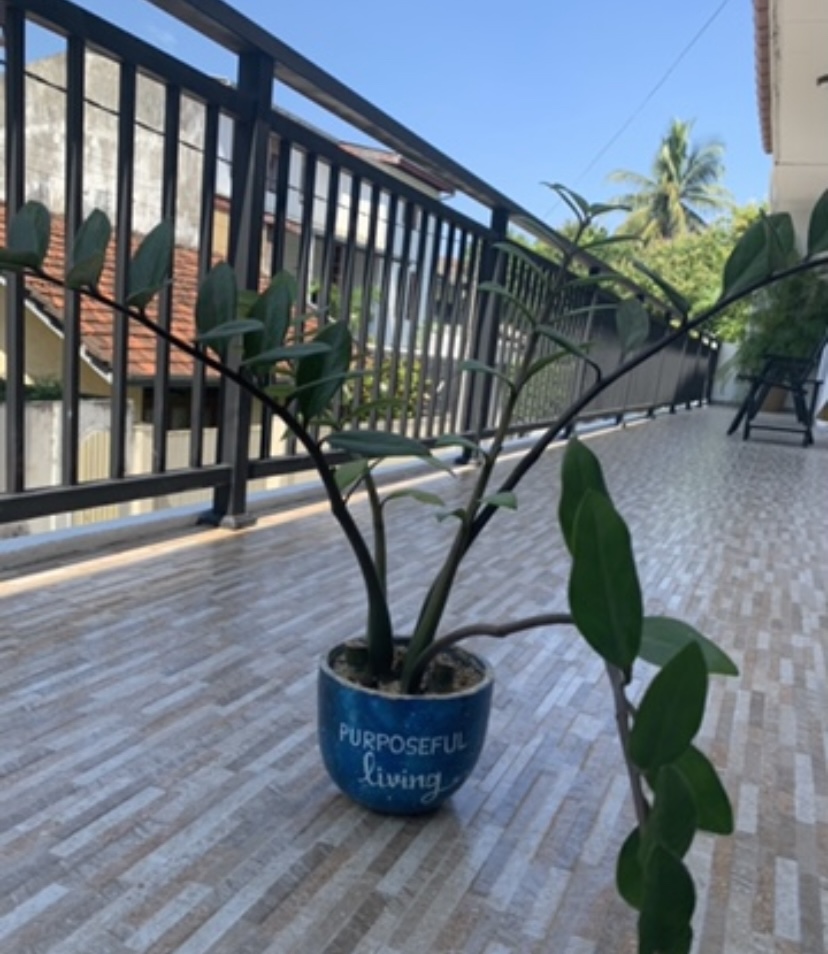
A plant with the words Purposeful Living on the pot, given by my eldest daughter for Christmas 2020. This is a photo of it on the 1st of January 2023. It has grown with the thesis.
Purposeful Leadership contains two ideas, purposefulness and leadership, which cannot be simplified or explained using a short definition. This is substance for a book or many. I commence this series of blog posts, not knowing the nature of articles nor the number of articles. I allow the series to unfold as in the process of finding purposefulness.
I must start somewhere, hence let me explain purposefulness in an over-simplistic manner. Purposefulness is a mindset that guides thinking, decisions and actions, with the flourishing of life being given importance. Flourishing of life begins with one’s own life, that of family, team, organisational stakeholders, environment, society, and the world at large. It’s simply for the flourishing of all forms of life. Being purposeful is a challenging aspiration, given the cognitive, practical, psychosocial and contextual complexities of the world we experience. Nevertheless, it is a worthwhile pursuit as discussed in my doctoral thesis; Living Purposefully: An Inquiry into the Life of a Leadership Development Practitioner (De Silva, 2024). Leadership is about the intention and effort to influence oneself, and those connected with oneself in personal and work roles. Therefore, purposeful leadership is enacting self-, team- and organisational leadership for the flourishing of life.
Think of the last time you had to make a difficult decision. A time where options were difficult to pick from. A time where the more materialistically profitable option did feel right. I have faced many such situation. I would like to share my personal experiences to help shed some light on this dilemma.
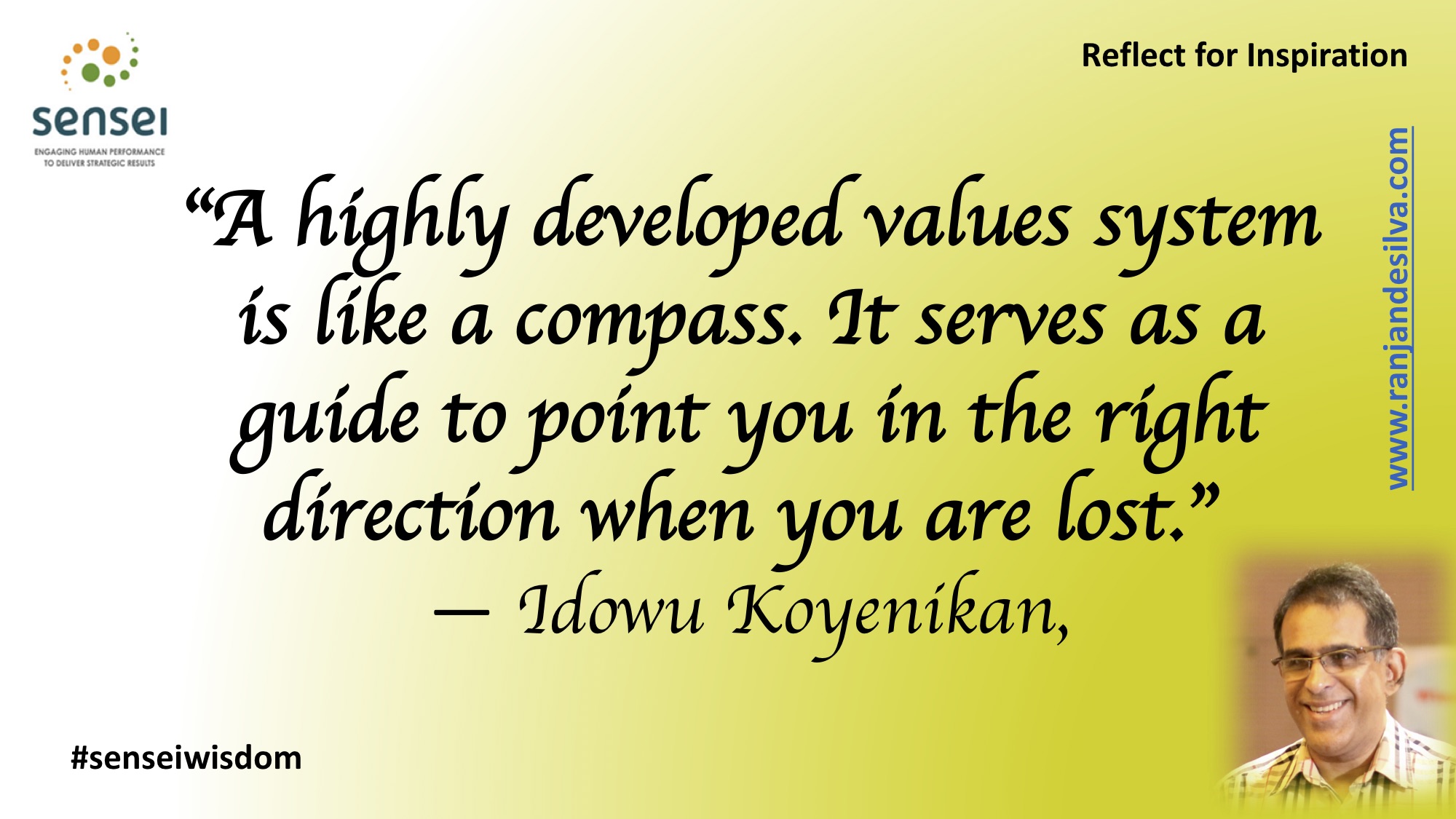
When I have such a dilemma I reflect on my aspired values to find direction as per the quote by Idowu Koyenikan in the visual above. The five values I attempt to live by are summarised I the following statement.
We inculcate values during our formative ages, influenced by family, teachers, religion and the society we live in. I always found it is difficult to ‘train’ people to live values as they are already part of each person. I also agree with the above quote by Jennifer Cruise; values do not take us get anywhere, they define us. Therefore what is the point of having values in an organisation and developing team members to live by organisational values.
Six questions you need to ask yourself to be the person you are destined to be – A presentation by Marshall Goldsmith.
Engage in this sincere presentation by Marshall Goldsmith and reflect on the six powerful questions he is prescribing. You may at-least start thinking in a manner that leads you to discover who you are meant to be. Enjoy the journey.
The following process can be used to create a learning experience for your team using this video.
As you watch this video, reflect on your attitude towards failure, rejection and setbacks etc. What steps would you take to reinforce your attitude or change your attitude to enjoy success?
Developing Purposefulness in Team Members – My presentation at the Asian & African Retail Congress in Mumbai India,
A presentation made to leaders in the retail industry at the Asia & Africa Retail Shopping Center Congress. Practical application of leadership and personal develop ent methods delivered with powerful concepts and personal experiences.
As you watch this video, reflect on steps you are taking and further steps you can take to develop purposeful team members in Your organisation.
The following process can be used to create a learning experience for your team using this video.
Step 1 – A moderator (an expert from your company) to open the session, explaining the importance of the session.
Step 2 – Show the video – let participants absorb, take notes and write down questions to ask later
Step 3 – Have a Q&A session and a discussion
Step 4 – Agree on actions to be taken based on the video
Step 5 – Participants to say how the session was useful.
As you watch this video, reflect on your motivation (motive to take action). How does emotion (energy in motion) creates that motivation from within that helps us make a difference?
Ron Kaufman discusses his New York Times bestselling book Uplifting Service,
A proven path to delighting your customers, colleagues, and everyone else you meet. The book exposes a massive wound in a subject area that has become buried in weak distinctions, inadequate practices, and popular but shallow clichés. Ron explains the 5 key elements to build a self-sustaining service culture that can uplift an individuals, transform an organization, and ultimately change the world.
As you watch this video, reflect on steps you can take to engage the fickle minds of your children, team members and yourself.
The following process can be used to create a learning experience for your team using this video.
Step 1 – A moderator (an expert from your company) to open the session, explaining the importance of the session.
Step 2 – Show the video – let participants absorb, take notes and write down questions to ask later
Step 3 – Have a Q&A session and a discussion
Step 4 – Agree on actions to be taken based on the video
Step 5 – Participants to say how the session was useful.
A post-lunch keynote by Ranjan De Silva that kept an audience of almost a 1000 professionals entertain, energised and engaged at the National HR Conference of Sri Lanka, organised by the Institute of personal management (IPM). A real life testimony of how to engage the Fickle Mind.
As you watch this video, reflect on steps you can take to engage the fickle minds of your children, team members and yourself.
The following process can be used to create a learning experience for your team using this video.
Step 1 – A moderator (an expert from your company) to open the session, explaining the importance of the session.
Step 2 – Show the video – let participants absorb, take notes and write down questions to ask later
Step 3 – Have a Q&A session and a discussion
Step 4 – Agree on actions to be taken based on the video
Step 5 – Participants to say how the session was useful.