A luminous crystalline ring hovers above a miniature landscape of urban ruins and glowing embers.
As the war in the Middle East continues to unfold, it is difficult to remain untouched by the images, stories, and consequences that surround us. Families displaced, lives lost, travellers stranded far from home, and entire societies living under sustained fear and uncertainty. In moments such as these, any reflection on leadership must begin with humility.
It is important to acknowledge something that is often overlooked in conversations about conflict: those engaged in war rarely see themselves as acting without purpose. On the contrary, every party involved believes it is acting in the service of its people, its values, and its understanding of justice or security. The challenge, therefore, is not an absence of purpose, but the narrowness of the purposes being pursued.
When purpose is defined only within national, ideological, religious, or territorial boundaries, it can legitimise actions that cause immense suffering beyond those borders. Purpose, when disconnected from a wider moral horizon, becomes a powerful justification for harm.
This raises a difficult but necessary question: What would it mean to act purposefully in a world at war?
There is a compelling seduction in goal setting. A tidy metric. A date on the calendar. A trophy on the shelf. Goals promise clarity and certainty in a complicated world. Yet, as I have often observed in leadership work and personal reflection, the same mechanism that energises performance can also distort judgement, corrode relationships, and narrow our field of vision until only the finish line seems to matter.
This is the problem with goals; not that they exist, but that they so easily become all that exists.
When organisations get obsessed with goals, people begin to feel the heat of retribution and repercussions. Meeting the number eclipses meeting the need. Targets become a test of capability rather than a tool for learning. Under pressure, talented individuals often drift into unhealthy competition and, at times, resort to unethical means. Collaboration gives way to territorialism. Short-term wins get overvalued; long-term consequences get discounted. Leaders unwittingly convert their teams into anxiety machines, characterised by being busy, brittle, and perpetually braced for impact.
Purposeful leadership is often understood as a progression: purposeful self-leadership, followed by purposeful people leadership, and eventually purposeful organisational leadership. While this sequence is a helpful entry point, it does not reflect how leadership is actually lived. In practice, purposeful leadership is not linear. It is cyclical, relational, and complex. Each form of purposeful leadership both shapes and is shaped by the others, forming a living system rather than a developmental ladder.
Purposeful self-leadership is the inner anchor of this system. It is the ongoing practice of aligning values, beliefs, intentions, and actions with a deeper sense of purpose. This inner work is not private or abstract. It shows up most clearly when leaders are under pressure, navigating ethical tension or difficult trade-offs. When leaders lack inner coherence, purpose becomes performative. When they are grounded in purposefulness, they are better able to act with integrity, resist expedient compromises, and hold responsibility with maturity.
Purposeful people leadership is where inner purpose meets relational reality. Purpose is tested not in declarations, but in conversations, decisions, and everyday interactions. The way leaders listen, build trust, address conflict, and hold accountability reveals whether purposeful self-leadership is truly embodied. Purposeful people leadership translates inner alignment into lived experience, shaping how people feel, engage, and commit to the organisation.
As we welcome 2026, many of us feel the familiar mix of gratitude, exhaustion, and anticipation. The year has given us moments we are proud of, and moments that remind us how imperfect, human and evolving we are. Before we rush into 2026, this is a valuable moment to pause, to breathe, and to reflect on how purposefully we lived in 2025.
Over the years, through the Purposeful Leadership series, I have written about the importance of aligning who we are, how the quality of our leadership begins with the quality of our inner world and how we lead. As I look back on 2025, I am reminded again that purposefulness is not a grand concept; it is a daily practice.
A simple way to explore your own experience of purposeful leadership is through three lenses: purposeful self, purposeful team, and purposeful organisation.
In the previous article, we explored how to develop purposeful organisational leadership. In this post, we focus on the complexities of purposeful organisational leadership and potential remedies.
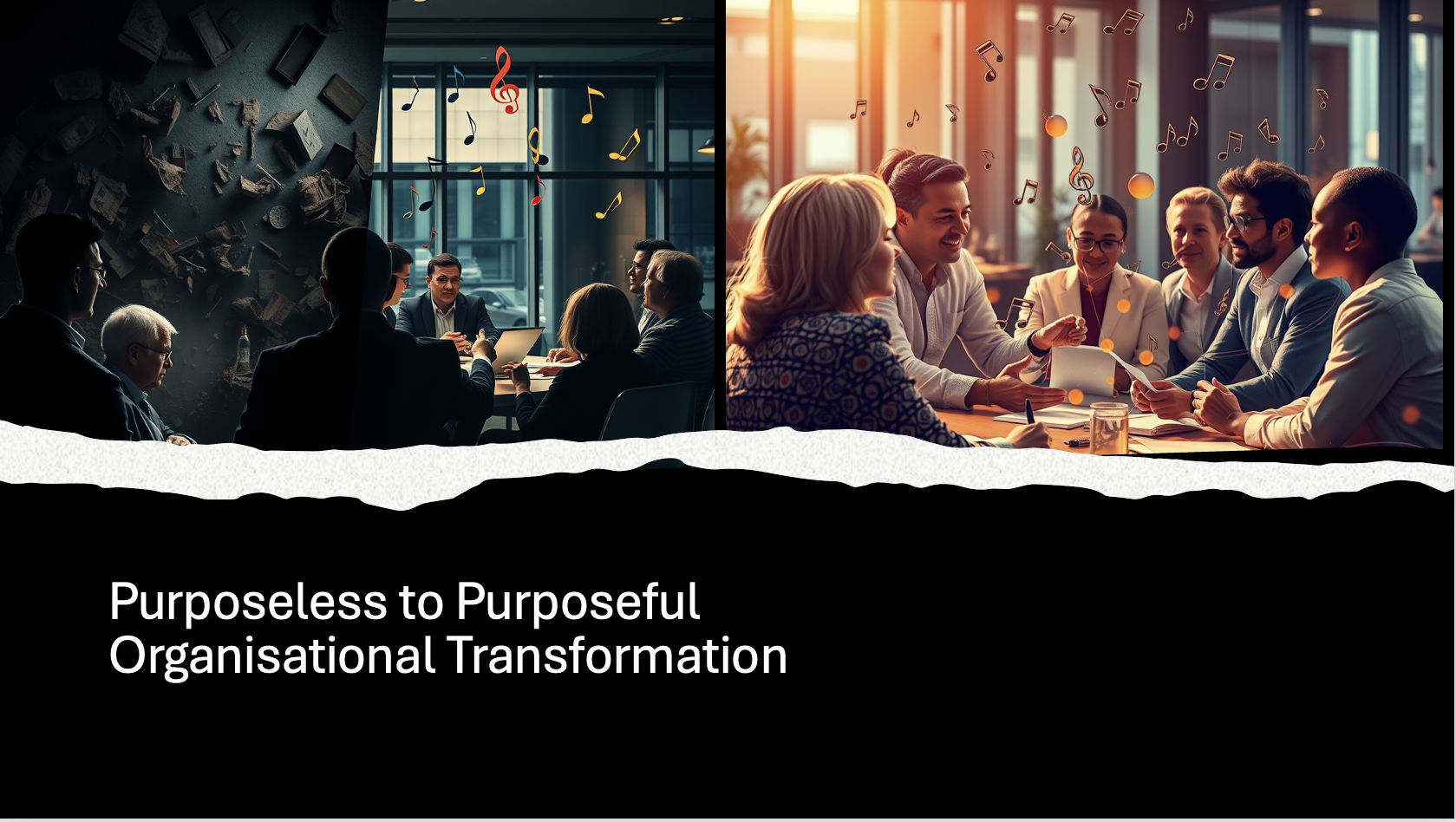
Organisations do not become purposeful by proclamation; they become purposeful by orchestration. And orchestration is complex. It asks leaders to conduct a score that balances markets and meaning, governance and grace, pace and patience. If purposeful people leadership is the dance with paradox at the human scale, then purposeful organisational leadership is that paradox amplified across systems. The stakes are higher, the variables multiplied, the pressure relentless. Yet the beauty is also greater, because purposeful organisations can hold the space where profit and flourishing meet.
The first complexity is when the purpose is only a brand. Organisations often craft eloquent purpose statements, then proceed to pursue them with methods that quietly contradict the message. Purpose is not merely narrative; it is action. When we violate this principle, people quickly learn that the banner on the wall is not the truth on the floor. To lead purposefully at the organisational level, we must ensure that strategy, structure, systems, and culture are not just aligned conceptually, but coherent behaviourally. This coherence is evident in how we behave, especially when performance pressures intensify.
In the previous article, we explored what purposeful organisational leadership means and why it matters. In this post, we focus on how leaders can intentionally develop purposeful organisational leadership, turning purpose from a statement into a lived reality across the organisation.
Start with Leadership Commitment
“I hold the view that leaders are better able to contribute to the flourishing of life if their actions are guided by a deeper sense of purpose” (De Silva, 2024, p.6). Therefore, purposeful organisational leadership needs to begin at the top. Senior leaders must embrace the organisation’s purpose as a guiding principle for decisions and behaviours. This commitment is not symbolic; it requires courage to prioritise purpose even when short-term pressures tempt compromise.
Make the Organisational Purpose Your Guiding Light
The starting point for developing purposeful organisational leadership is a clear purpose statement. This is not a marketing slogan; it is the organisation’s reason for being and its unique contribution to the flourishing of life. From this foundation, leaders can craft a mission statement that defines how the purpose will be delivered and set Big Hairy Audacious Goals (BHAGs) to drive long-term success.
In the previous articles, we explored the first two branches of purposeful leadership: self and people. In this post, we turn to the third and final branch, purposeful organisations. If purposeful leadership begins with the individual and extends to teams, its ultimate expression is in organisations that are guided by purpose rather than vision.
Beyond Vision: Why Purpose Matters
Traditional organisations often define themselves through vision statements, aspirations of what they want to become. While visions can inspire, they are frequently inward-looking, focused on growth, dominance, or profitability.
Purposeful organisations, by contrast, start with a deeper question: Why do we exist? The answer is not about market share or shareholder value; it is about contribution to the flourishing of life. “Flourishing workplaces require the re-creation of organisations to give life to a truly postmodern era of collaboration in order to facilitate organisations to flourish on this planet for future generations” (De Silva, 2024).
Purpose is not an add-on, like corporate social responsibility (CSR). It is not a department or a project. It is the organising principle of the entire enterprise. Every policy, process, and decisions flow from the purpose. Every role is designed to serve it. Every strategy is evaluated against it. Purpose becomes the compass that guides the organisation through daily decisions, complexities and change.
In the previous article, we explored how leaders can intentionally develop purposeful people leadership, an approach that transforms teams and organisations by aligning individual purpose with collective contribution.
While this aspiration is noble and deeply impactful, it is not without its complexities. In this post, we examine the challenges, paradoxes, and tensions that arise when we choose to lead people purposefully.
Cognitive Aspects
One of the first complexities arises from how people cognitively make sense of the notion of purposefulness. The concept of “purpose” is often misunderstood or conflated with goals. While goals are specific outcomes we strive to achieve, purpose is the deeper reason behind those goals, the “why” that gives them meaning. This distinction is not always clear, and many team members may struggle to grasp its relevance. Some may view purposefulness as abstract or philosophical, disconnected from the practical realities of work.
Moreover, individuals interpret purpose through the lens of their own experiences, beliefs, and values. What feels purposeful to one person may seem irrelevant or even threatening to another. Leaders must navigate these differences with sensitivity, helping people explore and articulate their own understanding of purpose without imposing a singular definition. This requires patience, dialogue, and a willingness to embrace ambiguity.
In the previous article, we explored the concept of purposeful people leadership and its importance. In this post, we delve into how leaders can intentionally develop purposeful people leadership, an approach that transforms teams and organisations by aligning individual purpose with collective contribution.
Purposeful people leadership begins with the leader’s own sense of purpose. When leaders connect their role to their higher purpose, they begin to see their primary responsibility not just as managing tasks, but as developing their team members, purposefully. This shift in perspective changes everything. The team is no longer a means to an end; it becomes the very reason for leadership. The leader’s purpose expands to include helping team members discover their own purpose and align it with meaningful roles.
This development process starts with purposeful conversations. Leaders engage with team members to understand their aspirations, strengths, struggles, concerns about their world and values they aspire to live by. They help individuals reflect on their personal purpose, articulate a purpose statement and explore how it can be expressed through their work. When people are placed in roles that resonate with their purpose, they flourish. Their contribution becomes authentic, passionate, and sustainable.
Purposeful leadership extends beyond the self. Once the leader becomes purposeful, the natural next step is to help others, team members, and teams become purposeful. This is not a directive process but a deeply human one, rooted in example, empathy, and engagement. In this article, we explore the second branch of purposeful leadership: leading people purposefully.
Purposefulness in people is transformative. It improves their personal lives, relationships, health, and peace of mind, and this inevitably enhances their effectiveness and contribution at work. The workplace becomes more than a place of transaction; it becomes a space of meaning. Families benefit too, as individuals carry their sense of purpose home, influencing their roles as parents, partners, and community members.
I have experienced this transformation personally. At the age of 27, I had climbed the corporate ladder rapidly to become a director of two subsidiaries of John Keells Holdings, Sri Lanka’s leading conglomerate. At the time, I was driven by ambition and the goal of professional success. I worked long hours, including weekends, and neglected many aspects of my life. I was overweight, frequently ill and hospitalised, disconnected from my young family, absent from church, and unaware of the importance of developing and empowering my team. I had no sense of purpose, only a relentless pursuit of achievement.
Everything changed when I discovered the notion of purposefulness and wrote the draft of my first purpose statement. I began going to the gym, spending quality time with my family, returning to church, reading, cutting excessive costs, investing the savings, and cultivating emotional maturity through meditation. This personal transformation awakened a desire to help my team grow. I began teaching them about purposefulness and supporting their development. As a result, my quality of life and work improved significantly. It was no longer a choice between work and life; it became a commitment to both work and life, harmoniously.
My doctoral research reinforces this understanding. As I wrote in my thesis:
“My research suggests that being purposeful helps understand life from a more holistic and altruistic manner, leads one to conduct life with decent human values, helps make choices beneficial to the flourishing of life, improves caring for the well-being of family and self, and choosing vocations which are aligned with an evolving life-purpose. Adjusting one’s lifestyle in this manner takes courage, determination, and self-discipline. However, persisting with such an aspiration leads to an improvement in the quality of life, generating happiness which, in turn, encourages persisting in being purposeful.” (De Silva, 2024)
I invite you to reflect on how you are leading people. Are you helping them become purposeful? Are you creating conditions for their flourishing? If not, what needs to change?
You may explore literature from my blog http://www.ranjandesilva.blog, my website http://www.ranjandesilva.com, and other sources. Speak with your trusted advisor. We will further explore the notion of purposeful leadership and methods of transformation in the upcoming blog posts.
In the next article of this series, we will explore how to develop purposeful people leadership, how leaders can intentionally cultivate purposefulness in others through structured development, coaching, and empowerment.
References
De Silva, R. L. G. (2024). Living Purposefully: An Inquiry into the Life of a Leadership Development Practitioner. (Doctoral dissertation, Hult Ashridge).
In the last post, we explored how to develop purposeful self-leadership by articulating a purpose statement and taking small, meaningful steps to live in alignment with it. While this process is deeply enriching, it is not without its challenges. In this post, we explore the complexities of attempting to enact purposeful self-leadership in our lives (De Silva, 2024).
Understanding the Notion of Self-Leadership
The idea of self-leadership is inspiring. It suggests that we can take charge of our lives, lead ourselves with clarity and conviction, and live in alignment with our purpose. However, understanding this notion deeply can be complex. Many mix purpose with goals when in fact it is not. A goal becomes more meaningful when it is based on a purpose. It requires us to accept responsibility for our thoughts, emotions, and actions—something that can feel both empowering and intimidating. The concept may seem abstract or idealistic, especially when life feels uncertain or overwhelming.
We explored the notion of Purposeful Self-leadership in the last post, part 3 of this series titled ‘Start with the Self’. Today we explore how to develop Purposeful Self-Leadership and in the next post, we can explore the complexities of such an aspiration. In the first two articles of this series, we explored the two key concepts of purposeful leadership: purposefulness and leadership, and the three branches of purposeful leadership: self, people, and organisations.
Developing Purposeful Self-Leadership starts with articulating a purpose statement depicting our sense of purpose at the current stage of life. The first version of the purpose statement is only a glimpse of our purpose as finding purpose is a lifelong journey. However, having a sense of purpose begins the quest and gives us the drive and desire to be purposeful. Being purposeful improves our clarity about our life purposes and helps us fine-tune our purpose statement, leading to us being more purposeful. This cyclical process not only improves our sense of purpose and purposefulness but also attracts abundance to succeed in vocations aligned with our life purpose, gives us happiness and peace of mind (De Silva, 2024).
Purposeful leadership starts with the purposefulness of the individual holding the leadership role. How can a purposeless individual help people and organisations to be purposeful? I am not claiming that all leaders are purposeful self-leaders. Many are not, and as a result, the people and businesses are not purposeful. In this article, we explore the notion of purposeful self-leadership. Given the need to keep these articles short, we will explore how to develop purposeful self-leadership and the complexities of such an aspiration in subsequent articles. In the first two articles of this series, we explored the two keywords of the concept of purposeful leadership: purposefulness and leadership and the three branches of purposeful leadership: self, people and organisations.
A useful question to ask at the outset is what is purposefulness and how do we know we are purposeful?
In the first article of this series, published last month, we explored the two keywords of the concept of purposeful leadership: purposefulness and leadership. As I mentioned earlier, I allow the series to unfold as in the process of finding purposefulness. Being purposeful means creating a positive impact on the people and environment one encounters (De Silva, 2024). As I reflected on this series, the idea of writing about the three branches of purposeful leadership emerged.
I use the metaphor of ‘branches’ rather than categories, boxes, or containers because I see the three core areas of purposeful leadership growing in unison, but at different speeds and proportions, much like the branches of a tree. The bigger branches grow stronger but perhaps more slowly, while the smaller branches grow faster but are not as strong. However, all branches, big or small, have a purpose in the growth of the tree.
A plant with the words Purposeful Living on the pot, given by my eldest daughter for Christmas 2020. This is a photo of it on the 1st of January 2023. It has grown with the thesis.
Purposeful Leadership contains two ideas, purposefulness and leadership, which cannot be simplified or explained using a short definition. This is substance for a book or many. I commence this series of blog posts, not knowing the nature of articles nor the number of articles. I allow the series to unfold as in the process of finding purposefulness.
I must start somewhere, hence let me explain purposefulness in an over-simplistic manner. Purposefulness is a mindset that guides thinking, decisions and actions, with the flourishing of life being given importance. Flourishing of life begins with one’s own life, that of family, team, organisational stakeholders, environment, society, and the world at large. It’s simply for the flourishing of all forms of life. Being purposeful is a challenging aspiration, given the cognitive, practical, psychosocial and contextual complexities of the world we experience. Nevertheless, it is a worthwhile pursuit as discussed in my doctoral thesis; Living Purposefully: An Inquiry into the Life of a Leadership Development Practitioner (De Silva, 2024). Leadership is about the intention and effort to influence oneself, and those connected with oneself in personal and work roles. Therefore, purposeful leadership is enacting self-, team- and organisational leadership for the flourishing of life.
Six questions you need to ask yourself to be the person you are destined to be – A presentation by Marshall Goldsmith.
Engage in this sincere presentation by Marshall Goldsmith and reflect on the six powerful questions he is prescribing. You may at-least start thinking in a manner that leads you to discover who you are meant to be. Enjoy the journey.
The following process can be used to create a learning experience for your team using this video.
Leadership – A poem by Spatula – Read by Mathew Coger
As you listen to this poem, reflect on your current attitude about leadership. Does this move you into thinking of doing what you are doing as a leader or to change your leadership approach? What baby steps would you take to reinforce your good leadership behaviours and/or transform.
Developing Purposefulness in Team Members – My presentation at the Asian & African Retail Congress in Mumbai India,
A presentation made to leaders in the retail industry at the Asia & Africa Retail Shopping Center Congress. Practical application of leadership and personal develop ent methods delivered with powerful concepts and personal experiences.
As you watch this video, reflect on steps you are taking and further steps you can take to develop purposeful team members in Your organisation.
The following process can be used to create a learning experience for your team using this video.
Step 1 – A moderator (an expert from your company) to open the session, explaining the importance of the session.
Step 2 – Show the video – let participants absorb, take notes and write down questions to ask later
Step 3 – Have a Q&A session and a discussion
Step 4 – Agree on actions to be taken based on the video
Step 5 – Participants to say how the session was useful.
Ron Kaufman discusses his New York Times bestselling book Uplifting Service,
A proven path to delighting your customers, colleagues, and everyone else you meet. The book exposes a massive wound in a subject area that has become buried in weak distinctions, inadequate practices, and popular but shallow clichés. Ron explains the 5 key elements to build a self-sustaining service culture that can uplift an individuals, transform an organization, and ultimately change the world.
As you watch this video, reflect on steps you can take to engage the fickle minds of your children, team members and yourself.
The following process can be used to create a learning experience for your team using this video.
Step 1 – A moderator (an expert from your company) to open the session, explaining the importance of the session.
Step 2 – Show the video – let participants absorb, take notes and write down questions to ask later
Step 3 – Have a Q&A session and a discussion
Step 4 – Agree on actions to be taken based on the video
Step 5 – Participants to say how the session was useful.
A post-lunch keynote by Ranjan De Silva that kept an audience of almost a 1000 professionals entertain, energised and engaged at the National HR Conference of Sri Lanka, organised by the Institute of personal management (IPM). A real life testimony of how to engage the Fickle Mind.
As you watch this video, reflect on steps you can take to engage the fickle minds of your children, team members and yourself.
The following process can be used to create a learning experience for your team using this video.
Step 1 – A moderator (an expert from your company) to open the session, explaining the importance of the session.
Step 2 – Show the video – let participants absorb, take notes and write down questions to ask later
Step 3 – Have a Q&A session and a discussion
Step 4 – Agree on actions to be taken based on the video
Step 5 – Participants to say how the session was useful.
Inspirational speeches and interviews by Jeff Bezos
As you listen to this compilation of speeches and interviews of Jeff Bezos reflect on what makes you passionate and what you can you do to allow passion find me?
Listen to the wisdom of A. P. J Abdul Kalam in a compilation of his speeches and interviews. Reflect on the message that matters most to you. The variety of insights are so diverse and insightful, each person listening to this will takeaway gems of wisdom most relevant to you. Reflect on a change in attitudes, behaviours and actions that you will make as a next step.
Empathy & Perspective, an inspirational Speech By Simon Sinek
Everyone can be a leader. Everyone don’t want to be a leader. Everyone don’t have to be a leader. You need to love your people to be a leader. As you listen to this inspirational speech, reflect on if you love being a leader. If not why not? What steps would you do?
HPI is the sum total of the actions, interactions, behaviors and collaboration of leaders, teams and individuals at all levels of a business that have direct or indirect impact on business performance. HPI is the answer to measuring the quality of organisational cultures that is vital for performance improvement. It also works as a tool to help make strategic decisions that enable creating a winning work culture.
A presentation by Ranjan De Silva at the Bangalore HR Summit 2011, titled HPI at work at Agora, the leading supermarket chain in Bangladesh.
The following process can be used to create a learning experience for your team using this video.
Step 1 – A moderator (an expert from your company) to open the session, explaining the importance of the session.
Step 2 – Show the video – let participants absorb, take notes and write down questions to ask later
Step 3 – Have a Q&A session and a discussion
Step 4 – Agree on actions to be taken based on the video
Step 5 – Participants to say how the session was useful.
This is one of my favourite pictures that depicts the essence of learning. This is an executive coaching process underway for senior executives of the John Keells Holdings at the Cinnamon Citadel Hotel in Kandy, the Hill Capital of Sri Lanka. A peer coaching process where peers who participate in the coaching process, becomes a part of the coaching team together with the coach.
The beanbags and the dress code signify the informality of the process, the blend of colours signifies the diversity of the aspirations, hopes, concerns, issues, methods and solutions of the participants. The disorderly nature of the white chairs in the background with bags thrown around signifies the messiness that needs to be experienced in the learning and growth process. The flip charts signifies the formality of the work to be done. The sweets, water, snacks and tea provided shows the care taken to ensure the comfort of the participants. The intense listening and focus of the participants shows the seriousness, rigorous and the respect show to each other and the process.
Overall a beautiful blend of the soft and the hard, the messiness and the orderliness, the informality and formality, the soft and the hard touching hearts and minds for real, purposeful transformation.
People, Technology or Innovation – A candid discussion between Kamal Munasinghe and Coach Kamrul Hasan.
Learn about what is required for business success; people, technology or business? Kamal, a CEO of a leading Apparel Manufacturer in Bangladesh talks about business using his own industry experience, responding to thought provoking question from Coach Kamrul Hasan. Gain a practical perspective from people who have been there, done that.
The following process can help you get good value from this video:
Step 1 – A moderator (an expert from your company) to open the session, explaining the importance of the session.
Step 2 – Show the video – let participants absorb, take notes and write down questions to ask later
Step 3 – Have a Q&A session and a discussion
Step 4 – Agree on actions to be taken based on the video
Step 5 – Participants to say how the session was useful.
Please send a message if you would like to receive a white paper that can help in your learning process.
I hope this learning process was useful in providing online learning to your team during the current down time so that they would be kept positive, motivated and sharp so that all of you would be geared to perform with excellence during the crisis and after.
Learn how to be a better leader by using mindfulness practices. This is a skill which is even more important during times of anxiety when your mind is full. Learn how to empty your mind of the anxiety, worry, clutter etc. so that you can fully focus on your teams and inspire them to perform at their optimum.
I hope this could be useful in providing online learning to your team during the current down time so that they would be kept positive, motivated and sharp so that all of you would be geared to perform with excellence during the crisis and after.
The following process can help you get good value from this video:
Today’s learning video is for those in Senior Leadership Positions;
Leadership Complexities (10 mts) – Helps understand deep-seated leadership competencies and tips to deal with it. Includes free self assessment to find out own leadership complexity.
I hope this could be useful in providing online learning to your team members, family, friends and self during the current down time so that they would be kept positive, motivated and sharp so that all of you would be geared to perform with excellence during the crisis and after.
Managing stress was at the center of a coaching discussion I had with a CEO a few months ago. He was very successful and his success is attributed to the hard work he put in to his job. He gave his job first place and was willing to work late in to the evening, work on weekends and travel extensively for the success of his organization.
He had not adequately developed his team to take over responsibilities as he preferred to get things done on his own. While this worked for a while, it was taking its toll when the organization grew to a larger scale. He was also having issues at home as his two teenage sons had lost interest in studies and sports and preferred a lazy life engrossed in video’s and games using the expensive devises the father had purchased for them. His wife had given up trying to get him involved in family matters and was trying to manage on her own, but the absence of the father’s love, guidance and attention could not be compensated adequately by her. This is a source of stress when he returns home.
Let’s first try to understand what is ‘Natural-ability’ before trying to understand what your Natural-ability is and how to use this potent idea in improving your effectiveness individually and as a team.
Natural-Ability is a description for a level of ability. To simplify it let me offer four broad levels of ability. At the bottom is ‘Inability’, where we just can’t do a particular task. The next level is ‘Learnt-ability’, where we can do a particular task. The third level is, ‘Excellent’ where we not only can do a particular task, but we can do it well. We can get up to ‘Excellent’ level through training and developing our skills. But to get to the fourth level, ‘Natural-ability’ we would not only be really good at doing a particular task, but we are passionate about, it energizes us and it inspires others. It is simply something natural in us. Therefore I believe we cannot get to the level of Natural-ability by training ourselves, it should be within us. It is a word used to describe your natural strengths. It also highlights your responsibility to put your talents to work for the shared purposes of those with whom you make a commitment of this tremendous energy.
We are one of seven billion people in this world and each one of us sees the world from our own paradigm. This short blog post will examine the dangers of getting imprisoned in a paradigm and the benefits of becoming a prism as prisons are restricting and prisms are reflecting.
For example, when it comes to a decision of buying a family car, each family member would look at the decision from a different paradigm. The father might look at technical performance and fuel efficiency, the mother might look at the spaciousness and colour scheme, the teenage son might look at how classy it looks and how fast it can go and the teenage daughter may not care about any of this. When each family gets prisoned in their paradigm, they will not be able to come out of it to look at the decision from other paradigms, leading to possible misunderstandings, conflicts and even permanent damage to the quality of relationships.
Therefore the question is, how do we get out of the paradigm prison?
What makes a difference between an ordinary leader and an extra ordinary leader?
While there could be many reasons for this difference, I would like to propose the idea of ‘Purpose’.
I remember the time where I was responsible for business results in a company before I found my purpose. My primary focus is to achieve profit target of the company. This was pursuing a goal set by my company; it was not even a purpose. My life was about going to work every day, making decisions on how best to be better than competitors and using (yes using them without thinking of their growth & welfare) the people allocated to me in achieving these goals. Unknowingly I was neglecting my health, spirituality, my relationships, my financial health and I was squandering my time. I remember those days where I was hospitalized with stress attacks, struggling to pay my bills, gaining weight and working long hours. Fortunately I had a drive to educate myself, perhaps to overcome the fear of financial challenges and the passion to spend time with my children, perhaps because blood is thicker than water and, as they were such adorable children.
My life changed when I was fortunate enough to write a purpose during the first Mastery of Self playshop I attended. What was powerful about the purpose was it helped me to know myself deeper and to see the life I am designed to live. Formulating a realistic five year and Continue reading “Power of Purpose for Leadership Success!”→
It is fascinating how we continue to look for the right answer. Perhaps it is because of schooling systems which expects us to know the ‘right answer’ in order to pass examinations. Perhaps it is because of interviews panels that expect us to know the right answers in order to qualify for a job. Perhaps it is because of management who expects us to make the right decisions to business problems.
But what is a ‘Right Answer’? Who decides its right? By what standards do we decide it is right? Who sets these standards? People come from different backgrounds, education, experiences, cultures, mind-sets etc. The variables are almost infinite. Therefore we are all unique and we see, hear, feel, smell and taste things differently. Furthermore each situation is different. Each situation is a collection of places, time of the year, people, infrastructure, concepts, brands, climate, culture etc. Again the variables are infinite.
In my blog post on the 7th of May 2014 titled ‘How great is your team?’ I promised to go into details of the 11 different aspects that make a great team. The first eight aspects regarding ‘Burning Platforms’, ‘Team alignment around critical goals’, ‘Clearly agreed way of working?’ ‘A great decision making process’, ‘Information flow is encouraged’, ‘Great leaders don’t mince their words’, ‘Positive Crisis’ and ‘ Great Conversations’ have already been posted in this blog. Here is the ninth installment; ‘Radical Action Conversation’.
Radical Action Conversations are authentic. They go beneath the surface and deals with ‘adaptive’ issues that hinders real execution. Such conversations deals with engagement issues, honesty issues, relationship issues etc. that people may generally try to avoid to maintain false harmony. It encourages team members to be in ‘Adult’ mode rather than ‘Parent’ or ‘Child’ mode as described in ‘Transactional Analysis’. Such conversations are about identifying and dealing with assumptions team members make in their decisions, prejudices, actions, relationships etc.
Consider this. Your organization is working on a product launch that requires coordination between planning, manufacturing, marketing, sales, legal, finance and supply chain teams. The project is running late and at the current speed the launch could be delayed by more than 2 months. This can give a major advantage to the competitors who are working on a similar product to meet the same need of the customer.
The discussions at the management meetings are very technical. They speaks about the delay in finding the right raw materiel, delay in gearing up distributors and delay in configuring machines in the factory. The team discusses this and decides on some steps to speed up, but the situation is the same at the next meeting. The team resorts to unproductive conversations such as fake, dormant and aggressive conversations to avoid facing the real issues. See my blog post ‘Great Conversations’ for more details of unproductive conversations.
This becomes a radical conversation when the team starts talking about the adaptive aspects such as the trust issues between the marketing and sales manager, the integrity concerns of the supply chain manager and the competency concerns of the factory manager. The team starts focusing on facts, when the focus changes to transforming rather than debating reality, when there is willingness to challenge and explore assumptions, when tough decisions are made based on these conversations and when clarity of accountabilities and commitments are achieved. Discussions at future meetings focus on tracking actions decided, agreeing on course corrections required and ensuring execution with both discipline and speed.
Such Radical Action Conversations will see relationships growing rather than cliques being fostered and team capability clearly growing through the engagement. Radical Action Conversations requires skill and courage and it takes a lot of effort to develop team with this capability. However this is not just useful but essential for a great team!
Remember the last time you were engrossed in a conversation? Conversation where real issues were discussed! Conversations that were authentic! Conversations that were value adding! Conversations that made time stand still! Conversations that made things happen! Conversations that got continued! These are the conversations that make great teams.
In my blog post on the 7th of May 2014 titled ‘How Great is Your Team?’ I promised to go into details of the 11 different aspects that make a great team. The first seven aspects regarding ‘Burning Platforms’, ‘Team Alignment Around Critical Goals’, ‘Does your Team have Clearly Agreed way of Working?’ ‘A Great Decision-Making Process for a Great Team’, ‘Information Flow is Encouraged’, ‘Great Leaders don’t Mince their Words’ and ‘Positive Crisis’ have already been posted in this blog. Here is the 8th installment regarding the 8th aspect; ‘Great Conversation’.
Have you ever wondered what makes a movie interesting? It is the crisis in the movie, even when it is a comedy or an animated children’s film there is some crisis and you will realise how boring that movie could be without that crisis. Similarly meetings become interesting when there is a crisis to deal with. A project becomes interesting when there is a crisis to deal with. A team becomes interesting when there is crisis between team members.
In my blog post on the 7th of May 2014 titled ‘How great is your team?’ I promised to go into details of the 11 different aspects that make a great team. The first six aspects regarding ‘Burning Platforms’, ‘Team Alignment around Critical Goals’, ‘Does Your Team have Clearly Agreed Way of Working?’, ‘A Great Decision-Making Process for a Great Team’, ‘Information Flow is Encouraged’, and ‘Great Leaders don’t Mince their Words’ have already been posted in this blog. Here is the seventh instalment regarding the 7th aspect; ‘Positive Crisis’.
Coming form an Asian background, we sometimes become over-cautious about the impact our communication makes on others, especially those senior to us. Therefore we end up saying things others want to hear, saying things that are not fully accurate or not saying things. This article tries to highlight some of the reasons behind this and some practical steps great leaders take to overcome it.
In my blog post on the 7th of May 2015 titled ‘How great is your team?’ I promised to go into details of the 11 different aspects that make a great team. The first five aspects regarding ‘Burning Platforms’, ‘Team Alignment around Critical Goals’, ‘Does your Team have Clearly Agreed Way of Working?’, ‘A Great Decision-Making Process for a Great Team’ and ‘Information Flow is Encouraged’, have already been posted in this blog. Here is the sixth installment regarding the 6th aspect; ‘Candour with Respect’’.
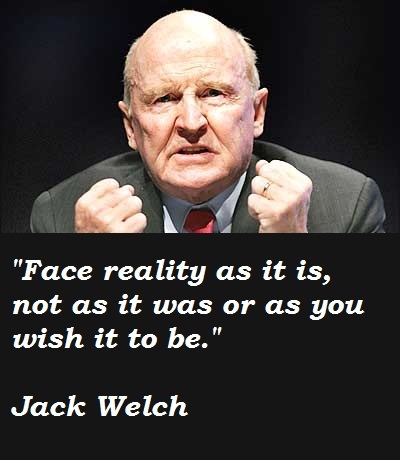
Great leaders do not just encourage candour with respect but they insist on it. Candour is a quality that is essential for a winning team. Jack Welch in his book ‘winning’ mentions that candour was a vital quality for any GE leader. Candour is about speaking out the truth with courage even if it would create conflict or hurt someone else. Good communicators also know how to select the right words, tonality and body language to make it as positive and productive as possible.
Great leaders insist on candour using the following mind-set, thinking and behaviours,
We love to hear good news! When bad news comes our way some times we tend to get upset, our body language and tonality shows that we are not pleased with the information and some resort to further unproductive behavior of shooting the messenger! Shooting the messenger can be in many forms. Some would question the messenger and ask them to justify the information. Some others may ridicule them as being negative or incompetent. Some others may even resort to retribution in the form of impacting their rewards and recognition negatively. However great teams have great leaders who behave positively and encourage information flow! In my blog post on the 7th of May 2014 titled ‘How Great is Your Team?’ I promised to go into details of the 11 different aspects that make a great team. The first four aspects regarding ‘Burning Platforms’, ‘Team alignment around critical goals’, ‘Does your team have clearly agreed way of working?’ and ‘A great decision-making process for a great team’ have already been posted in this blog. Here is the fifth installment regarding the 5th aspect; ‘Information flow is encouraged’. Great information flow requires the following mind-set, thinking and behaviours; Continue reading “Great Information Flow to Make Your Team Fly!”→
It was such an honour to be invited to write a message for the magazine to be published for the celebration of 50 years of priesthood for our beloved Father Stephen Abraham former Principal of St Anthony’s Collage Kandy, Sri Lanka.
My first encounter with Father Stephen was when he spoke at the college assembly soon after taking over as the principal of St Anthony’s College Kandy. While I was not mature enough to know a good speech from a bad one, the tone of his voice and the charisma of his personality were electrifying. I cannot remember any of the words uttered by this great man given the passage of time but his personality made us have mixed feeling of hope, respect and fear.
Father Stephen was such an encouragement to us sportsmen of the college. I cannot remember any match that he was not present at. He would always give us a word of advice and encouragement if he meets us before a game and he would remember to acknowledge us when he meets us at assembly or in the corridor the next day. He also insisted that we focus on our studies and it was always a treat when he walked in to class during the absence of a teacher or take an occasional class.
The quest for better leadership is still on and will continue to go on forever. One of the reasons for this is the ever-changing mindsets, expectations, challenges and demands presented by the ever-changing world around us.
There are many tools being used to create better Team Leadership and the next few blogs from me will analyse different tools and methodologies available to create better team leadership.
Let’s first see what is ‘Team Leadership’. Is it the same as or different to ‘Leadership’? Leadership can be used in many situations and ‘Team Leadership’ is an art of leading a team as against leading an individual or a set of individuals.
Team leadership has the following challenges that require the responses indicated.
1. Objectives of the team – The larger, more complex and the more challenging the objectives of the team, the type of ‘Team leadership’ differs. It will require skills such as making the team see the big possibilities, making the team believe in their collective ability to achieve the objectives, and it requires aligning the team under a common plan to achieve the objectives.
2. Size of the team – The larger the team is, the less time the team leader has to provide for each team member, the larger the team is, the more complex will be the relationship issues, the larger the team is, the more effort it will take to keep the team motivated. Appointing a few deputy leaders who take over responsibilities for smaller teams within the team and having more team interactions than individual interactions can overcome this.
3. Diversity of the team: The more diverse the team is, more the differences of opinions will be, more the potential conflicts will be and this will require more involvement of the team leader. Proactively helping team members understand each other through team building exercises and radical conversations, selecting the right mix of team members for various projects and investing more time on participative planning and briefing will help overcome this challenge.
4. Resources available (or not available): The resources available or not available for the team in relation to the tasks at hand can pose a challenge to the leader. The leader should use Continuous Improvement techniques such as Kaizen to get the team working together to make the most of existing resources.
5. Conflicts in the team – A team leader will lead different levels of conflicts in the team. Therefore it is important for the leader to be a good listener, mediator and counsellor using techniques from mainstream psychology, transactional analysis and Neuro Linguistic Programming to prevent, defuse or resolve such conflicts.
The concept of ‘The Burning Platform’ was first introduced by Daryl Conner who used the metaphor of an Oil Rig worker who had to leap into the water to save himself when the platform of the rig was burning. In this situation if the worker did not jump there was certain death as he would have got burned on the platform and jumping into the heated water with debris was possible death if he was not rescued within 20 mts. So he took the call based on the odds of saving his life although both options he had had a high risk of death. What he essentially tries to say is that sometimes we need to take a call in a hopeless situation such as a burning platform and such a call can ignite and motivate us to unite as a team and do the impossible.
Therefore counties unify when there is a burning platform. A historic example is Japan after world war 2. Similarly there are many examples of people uniting when there had been a suicide bomb attack, sports teams uniting after a heavy defeat, companies uniting when competitors launch a game changing product etc.
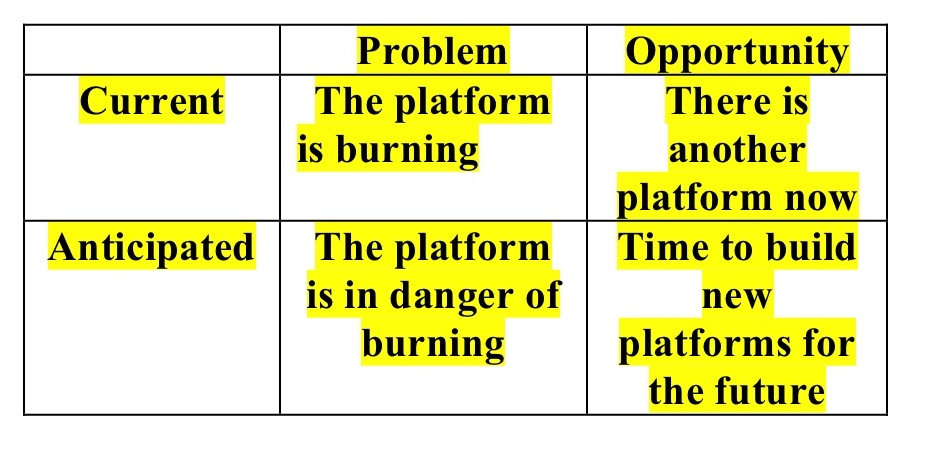
However the concept of burning platforms, if taken literally can be misunderstood to mean that a team needs a disaster to unite. There are 4 Types of burning platforms as shown in the following matrix.
Lets examine each of these burning platforms;
The Platform is burning: This is a problem faced by the team in the present. This means we are in trouble and need to take immediate action. Examples of this situation are; competitor has launched a game changing product, one of our factories have been destroyed by fire, A quality issue that has put us in the danger of loosing our biggest customer, trailing 0 – 2 in a soccer game, civil commotion affecting the supply of vital raw materiel etc.
The leadership response: In this situation the leader needs to gather the entire team and collect information regarding the situation from all team members, asses the crisis quickly, show the team how it can affect each member and the team, collect ideas on how to deal with the situation, formulate a plan and assign team members to take action. Given the situation and its personal impact, the team will [at least temporarily] put aside their differences and work together to deal with the situation. This process can bring diverse team members together, generate creativity, ignite the passion and create synergy. Teams coming out of such situations are generally stronger and are geared to achieve greater results. In this situation the leaders challenge is to convert fear and confusion into confidence and hope.
Leadership is about developing team members to carryout the important responsibilities in the organization. This is essential if we are to grow and take on higher-level responsibilities. Developing team members requires time. Therefore leadership is inefficient in the short run. However it is a great investment of our time and energy to reap near medium term to long-term results, as having a developed team will help produce more value and great results.
Given below are 10 common areas where this inefficiency can happen.
Getting the right team member in to the team: We need to first ensure the team member with the right attitude and skills are recruited into the team. This requires spending time on determining the profile of the ideal team member, preparing the right evaluation techniques and spending quality time evaluate the candidates.
Taking time to direct: When a new team member is recruited or transferred in from another area of the organization to our team it takes time to induct and teach. Time needs to be allocated to introduce the new team member to the other team members, work environment, mission, vision, values, customers, products and work processes.
Listening: It is important to actively listen to the team member to understand his/her level of absorption, development, enthusiasm, motivation and concerns. This will enable us to ensure the new team member feels at home soon, ready to take on responsibilities that we are planning to delegate.
Handing over responsibility: It requires us handing over a task that may have taken us 1 hour to complete and it takes our team members double that time as he/she consciously and carefully does the job as requires. We need to have patience knowing that there is a natural curve of gaining efficiency as the skill and confidence improves.
Detailed briefing: It is important to provide a detailed briefing for the responsibilities to be delegated. It requires determining how much of authority needs to be delegated. It requires documenting the details, some of which is in our mind and we do as second nature. Sometimes we neglect to provide the finer points thinking it is common sense. Sometimes what are common senses for us is not so common for others.
Checking work done: We need to also invest time to check the progress of work and the quality of work. This requires reading weekly updates, walking into the areas of operation, speaking to those on the job, discussing variances and brainstorming solutions.
Praising: We need to lavishly praise good work. We need to praise the progress in the process, not only wait for the outcome. While this can take time, it is an important activity to reinforce good behaviour.
Improvement feedback: We need to also give improvement feedback for areas that needs to be better. Instant feedback can be detrimental as it can go packaged with negative emotions such as anger. Therefore it is better to give it some time to cool down, visualize how best to most productively provide the feedback and do so, so that this becomes an effective development activity. The cooling down periods takes time.
Dealing with demotivation of others: Delegating responsibility to one person can demotivate another team member. Therefore it takes time to keep others informed, engaged in other value adding activity and communicate consistently so that we keep the entire team motivated.
Dealing with conflict: It is quite likely for conflict to arise between team members as they work on projects and various tasks as they discharge responsibilities delegated. Therefore it is the leaders responsibility to defuse and manage the conflict to create strong team bonding. This of course takes a lot of time and the energy.
Reporting up: The leader is ultimately responsible for tasks delegated and the reporting responsibility lies with the leader. When we were doing the tasks ourselves it was easy to report in detail as we were at the thick of everything. However when it is delegated we need time to get all the details, ask questions to get clarifications and write the report.
One of the most valuable assets of a leader is personal credibility. Credibility is a perception and we are perceived as credible by our habits. A habit is formed when behaviours are repeated over a period of time.
Here is an opportunity for you to do a self-assessment of your credibility. Given below is a list of 8 credibility habits and a brief explanation of each. In order to know your current level of credibility, read each value and mark a score from 1 to 5 [Poor to Excellent] in front of each habit. You could also give this list to your team members and ask them to rate you to see the difference between your self-assessment and the perception of others.
Show Up On Time: Rating: ____
Questions to ponder: Do I do things on time. Do I arrive at meetings on time? Am totally present, emotionally, mentally and spiritually in addition to just my physical self.
Do What You Say: Rating: ____
Questions to ponder: Do I make promises I can definitely keep even under pressure? Do I keep the promises I make? Do I under promise and over deliver? Continue reading “How credible are you?”→
With the celebrations of winning the world T20 2014 Cricket title still riding high and the entire nation positively charged, it would be a good time to reflect on the leadership lessons.
Lesson 1: Never give up: After having won the cricket 50 over world cup in 1996, Sri Lankan cricket has had ups and downs. Ups, mostly because of the cricket infrastructure in the country producing brilliant talent and downs mainly attributed to cricketing politics and administration. Sri Lanka has come to the finals of many a world level tournaments and ended up runner-up. This time around too, many were having fears of another loss in a final, but things went Sri Lanka’s way, not by accident but by design. Therefore leaders keep learning from mistakes, growing with challenges until they reach the target.
Lesson 2: Team work : While Sri Lanka became the world T20 Cricket champs no Sri Lankan player featured in the top 5 run scorers or wicket takers in the tournament. This is due to all players contributing their very best when conditions required them. Therefore a player like Kumar Sangakkara who failed to score much during all the games during the run up to the final, showed up and became the match winner at the final. A player like Rangana Herath who bowled Sri Lanka to victory in the crucial match against New Zealand was not very suitable for the conditions in some other matches. The player of the tournament was from India, the runner-up. Therefore there are no individual winners, but the team wins. Continue reading “Big Leadership Lessons from Little Sri Lanka”→
I had the fortune of helping out a person to overcome a highly stressful situation. Lets call him Frank.
He was quite a successful businessman and his success was partly due to a business partnership he forged with another individual who was more senior, who had more experience and who was more successful. Lets call him Robert. After awhile Robert had lost control of his lifestyle and had started to face some financial challenges too. Robert kept assuring Frank that it was a temporary cash flow issue that most companies go through.
After awhile Robert requested Frank for financial help and due to the gratitude he had for Robert, he responded. Frank was promised an early return of the loan. The loan amount was so big, it virtually wiped out all his savings; a part of it was reserved for his daughters’ higher education.
The promised day passed and Robert was not in a position to pay back. Many meetings with Robert and constant follow up did not help. Robert needed more financial help and mentioned that a new loan will help him seal a deal and get out of the financial mess, enabling him to pay back Frank. Frank gave the last bit of saving he had trusting his business partner who helped him to be successful.
Top Performance requires us to ensure that top teams are set up, developed, nurtured and rewarded appropriately. Most companies miss this important point. Here is a summary of the insights from the ‘Top Performance through Top Teams’ session held on the 21st of January 2014.
Inappropriate strategy deployed by the organisations to measure/improve business performance is one of the key reasons that teams remain average teams delivering average performance.
They focus too much on individuals
They focus too much on how to work than how it works (excessively process driven)
They create and run ‘Vertical Organisations’ – Hierarchies are created to fix responsibilities, which in turn dilute the authority resulting in indecisiveness / delays/non fulfilment of commitments made to all stakeholders
When an organisation faces a problem, if they have mediocre team members, they will strongly believe in maintaining/defending status-quo.
The biggest untracked cost of such companies is commitments made and not followed up.
Therefore following are the appropriate strategy for the organisations to measure/improve business performance.
Wish you a successful, growth giving and happy new-year of excellence.
New years every year brings so fresh hope to teams and leaders. This is the time we think of making the New Year the most spectacular year of all. While we start of with this intention we find it fizzles off really fast.
The reason for this is because a bigger mission or purpose does not support such efforts. This is because such efforts are not done with the engagement of the hearts and minds of the teams who are responsible to deliver such results. The reason for this is because such efforts do not have a disciplined approach.
Given below are a few simple steps that can help you to gear up for an amazing 2014.
Get together with your immediate team and go through the following process.
I had the fortune of meeting a Managing Director [MD] of a large group of companies many years ago and about a year ago, over a dinner he was sharing some of the challenges faced by his organizations. Since organizational challenges excites me and gets my creative juices flowing I guided him with some initial steps to over come them.
Later on he had requested me for a proposal to carry out a culture transformation in his organization. After having given the proposal we were not able to formalize an assignment as various challenges were coming our way.
Firstly he wanted to hire an experienced CEO for the organization and that took time. However I continue to guide him and was also giving him guidance in the process. Later on once the new CEO was hired, he had his own viewpoints about bringing in an external consultant and our assignment further delayed.
I first heard the saying; ‘Jack of all trades, is a master of none’ from my dad. While I took this as face value and later felt it is valuable mindset to have, I now wonder if this is true or false. On one hand it is humanly possible to be the best in all trades as there are millions of them. We would not have the time to master everything in a lifetime or just even explore them. Anyway I don’t think this statement suggests that anyone attempts to be a master of all trades.
We also don’t have the time in our lifetime to be a Jack-of-all-trades as well. But what do you think the original writer meant by the use of the word Jack. If it is the Jack from the pack of cards, then we are referring to the person who does all the work for the King and Queen. Therefore, by doing all the tasks required he learns many things, but will he ever be the master of any of those subjects.
Recounting my experience, I was in the collage rugby, athletic and chess teams. I was also a Boy Scout and I studied the subjects required to be an engineer. I believe I excelled in the engineering class when I lead a team of my classmates to make a electronic scale in the late 70’s. While it was very primitive and shabby we believe it was one of the first such attempts in Sri Lanka. It was viewed by the then President of the country J R Jayawardena and a later Prime Minister Ranil Wickremasinghe.
I took over the leadership of Apollo Hospital in Dhaka a few months ago to continue to stretch my self, to learn a new industry domain [health care] and to learn to lead a team of over 1700 consisting of some of the best medical consultants, specialist, doctors, nurses, patient care assistants, health care managers and other non-medical staff from this part of the world.
It is also a complex and highly responsible job and requires maintaining world-class operations in line with the JCI [joint commission international] standards the foremost health care accreditation in the world. It is only my hospital in Bangladesh and a hand full of hospitals in India, Singapore, Thailand and Malaysia can boast of this standard that is tough to get and maintain.
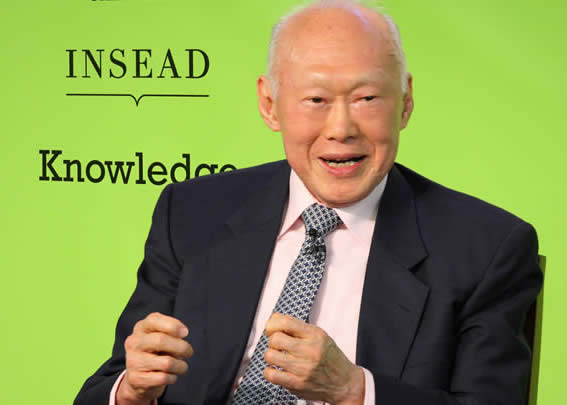
In addition to the above objective the spin off benefit I have got is the ‘wake up call’ regarding life in general. The knowledge I gather everyday being in this operation is amazing and that has made me more pay more attention to myself as well. It is in this backdrop that I received an email from one of my friends on getting the best out of life by Lee Kuan Yew.
One of the profound lines in a speech given by him was; “The human being needs a challenge, and my advice to every person in Singapore and elsewhere: Keep yourself interested, have a challenge.This made me read the rest of the article, leaving a side a list of other things I had planned to do and I felt really good that I found the time to read it. I am happy to share the entire article in its totality below. Please do take the time to read it. I do not know the source of this article, but I give credit to whoever wrote it and seek permission to re-produce it for the greater good of humanity.
If you’re not interested in the world and the world is not interested in you, the biggest punishment a man can receive is total isolation in a dungeon, black and complete withdrawal of all stimuli, that’s real torture.”
A picture of the Olympic Logo on the Tower Bridge taken from the London Bridge during my visit before the Olympics.
The 2012 Olympics that just concluded was one of the greatest manifestations of possibility that I had experienced.
My family and I were in the UK just before and during the opening ceremony that made us fortunate enough to feel the energy in the country this great spectacle was taking place. We were not able to witness any sporting events at venues at circumstances required us to return end of July, but we were fortunate to be able to witness this great spectacle on TV and the internet.
The first possibility that was manifested was the participation of almost all the countries of the world, 204 in total and every country having both male and female sportsman. All sports had a women’s version as well resulting in some teams such as USA having more women Olympians. What a great equalizer.
It was amazing to see conservative countries such as Saudi Arabia who do not permit women to drive, having women participating. I was fortunate to switch on the TV to see the women’s 800 m heat where Saudi Arabia’s Sarah Attar was running. Although she came last, she got the biggest applause to show that this was a victory for humanity.
World records were many manifesting that there is no end to improving human performance and endurance. Tianna Madison, Allyson Felix, Bianca Knight, Carmelita Jeter of the USA 4x100m relay team establishing a new world record at 40.82 destroying the 27-year old record and Nesta Carter, Michael Frater, Yohan Blake, Usain Bolt of Jamaican 4×100 relay team establishing a new world record at 36.84 will remain in our memories for ever. These amazing human beings showed that we can be individuals stars and teams at the same time.
Leaving the Agora team was one of the toughest things I had to do. The words, tears, flowers and gifts from the teams in various outlets, office, warehouse and distribution centre was simply heart-warming. I never realized I had made such an impact in the hearts and minds of over 700 team members over the 3 years I led them as their CEO.
After being in Team and Leadership Excellence consulting for 10 years, subsequent to 16 years in corporate life for 16 years as Director for Keells Foods and Keells Super, I took on a new interesting challenge as the CEO of the Agora Supermarket Chain [owned by the highly diversified Rahimafrooz Group] in Bangladesh in July 2009.
This was a 3 year assignment to prepare the company for Rapid expansion. I took over this assignment for 3 reasons; Firstly because Agora was close to my heart as I helped start it as a consultant in 2001 and hence I considered Agora my own baby and I wanted it to be successful. Secondly because I wanted to validate the guidance I give so many companies around the world as a consultant, by being in the hot seat for a while. And thirdly because I respect the Rahimafrooz Group and the family that owns it for running a company driven by ‘Values’ using ‘world-class’ management methods.
My dream was to make Agora a world-class company, the pride of Bangladesh and I write this blog with a mix of emotions that include happiness, sadness, fear, pride and hope.
Firstly I am extremely happy that we together created a company with a positive work culture that was built on the ‘Ultimate Aspiration’, ‘Values’, ‘Agora Aponjon Promise’ [Aponjon is the Bangla word for ‘dear one’ or ‘near one’ and this is the promise we deliver to our ‘guests’ or ‘Aponjon’], quality policy, good leadership, supportive team work and passionate team members. We also made the company profitable building on this culture and taking measures to improve the brand image, value to our guests, business knowledge, planning and execution. We also invested in a brand new state of the art distribution centre, new outlets and a new ERP system [SAP and WINCOR NIXDOEF]. All this helped the company to become profitable for the first time in my first year in office and become a leading revenue and profit contributor of the Rahimafrooz Group [the group that owns Agora an many other companies] providing better benefits and promotional opportunities to Agora’s team members.
I wish I had a job at Google, I hear some cool stuff about how people enjoy themselves. I wish I had a job in the UN, I hear I employees get to travel a lot. I wish I can join the Cabin crew at Emirates, I hear they pay really well. These are the types of dreams shared with me by so many who have sought my guidance at workshops, coaching session and on the social media networks.
So let me tell you how. First of all let me tell you achieving dreams are possible and it needs a lot of patience, dedication, hard work and perseverance. Those who have those dream jobs did not get their overnight. Soichiro Honda, the founder of the Honda motor corporation was a mechanic at Toyota when he dreamt that one day he will make his own car. He enrolled in a programme at Toyota designed to promote innovation and worked on a prototype which if accepted would bear his name with a profit share, an alternate path to making his own car. It took him 8 years of sacrifice, hardship, bombs and earthquakes to start making Honda motor cycles as a first step towards making cars. When people tell that Honda was an overnight success, he would have perhaps said, yes it is an overnight success that took me 8 years! See my YouTube video on http://ranjandesilva.com/videoandaudio/ to hear the full story of Honda’s path to success.
Some who we think are in dream jobs are dreaming about other jobs. This is because of human nature which wants to constantly improve and do better and there is nothing wrong with that too. However those who come into the correct arena will next think of going up the hierarchy in that arena.
Can you give me some advice on how to stay peaceful, when very close people around me are not supporting me at all? They can’t understand me and my mentality. This is a recent request for advice I received from one of my Facebook followers. There have been many such laments from people of various age groups and social situations and I felt it is good to share some thoughts on this for those who need the support.
The first attitude required when going through this challenge is to accept that everyone is ‘right’ from their point of view and conditions of life. When there is a gap or polarity in the points of views then one sees the other persons mentality, opinion, orientation, behaviours etc. ‘wrong’, ‘immoral’, ‘crazy’, ‘stupid’ etc. When there are billions of people living in this world with different mentalities, attitudes and points of view, if we try to make others understand that we are right and they are wrong, then we are on to a futile project that can damage relationships, create hostility and even wars!
As we take a short breather from the hectic cricket season where Sri Lanka played in South Africa, Australia and Bangladesh over the last 3 months with ups and down bringing joy and sadness to millions of Sri Lankans around the world, the leadership lessons have been tremendous.
The world cup loss to India on the 2nd of April 2011, which was surrounded with controversy [that I will not comment on as I do not have the required information to do], the resignation of the captain and the financial crisis of the cricket board had left the team in turmoil.
I was fascinated to see the video of Susan Boyle in Britain’s got talent 2009. Since the release of this video on ‘YouTube’ there have been over 100 million views of various versions of this video so far. What fascinates so many people is the manner in which a 47-year-old, unimpressive, unsophisticated woman who was written off, ridiculed and laughed off by the audience and the judges the moment she walked on to the stage, stunned the audience singing ’I Dreamed a Dream from Le Miserables’.
This is an inspiring story of the ability we have to break the chains that hold us back. A baby elephant is tied with a chain to a tree to keep it from wandering away. Wanting to be free, it pulls the chain and finds it too difficult to break. What we don’t realise is that the elephant when fully grown, continues to be tied by the same chain. The elephant moves trees and topples rocks. Scientifically it is proven that the elephant has the strength to break the chain. But it does not break the chain that it was tied to from the time it was a baby. The reason for this is simply because the elephant is conditioned to accept the chain as unbreakable. This will continue until someday the elephant breaks that chain by accident due to external pressure or for survival.
Recently I stumbled upon a TedX video of David Damberger titled: What happens when an NGO admits failure. It is a real eye opener for NGO’s who spends money in providing infrastructure such as tube wells. What they forget to do is investing some money on maintaining such infrastructure by employing people, training them and providing a source of funding and following up. David talks about how he saw this happening and making the same mistake himself. He sees how the tube wells provided were unusable a few years later due to this issue.
A success story in this aspect is the foundation for goodness run by Kushil Gunasekara in southern Sri Lanka. A village names ‘Seenigama’ he was fostering got completely wiped out due to the Tsunami on the 26th of December 2004. He got the support of various donors, well-wishers and those who were affected and re-built the village. He made it sustainable through various activities such as running 2 BPO’s and other industries and the village is a thriving one now. They have produced 6 national players for Sri Lanka in various sports among other achievements. It is a fascinating story and you can see their details at http://www.unconditionalcompassion.org/indexc.php.





















 We are one of seven billion people in this world and each one of us sees the world from our own paradigm. This short blog post will examine the dangers of getting imprisoned in a paradigm and the benefits of becoming a prism as prisons are restricting and prisms are reflecting.